Showing posts with label avengers. Show all posts

Friday, April 27, 2018

"Avengers: Infinity War" Nitpicks

So I don't have a formal review for "Avengers: Infinity War" yet. It's another one of those movies that I need to watch twice so I can see if it works as well without the elements of surprise, anticipation, and peer-pressure.

That said, I probably loved it. I definitely think critics are underrating it, possibly because "Black Panther" made them raise their standards. Meh, critics also didn't much like "Doctor Strange", and that's easily in my Top 5.

...Oh, did I forget to review "Black Panther"? Crap. Well, it was amazing. And comparing it to this movie makes about as much sense as comparing a meal prepared by a 4-star chef to a "Ziggy Pig". They serve different purposes, is what I'm saying.

Anyway, though I'm not ready to review "Infinity War", I did have a bunch of spoiler-y nitpicks I wanted to run through because I need to get it out of my brain. Also, because I imagine some people will find it entertaining. Also, because it should be possible to love a thing and still be able to nitpick at it.

SPOILERS ahead.


- Really guys? Did you REALLY have to kill the black guy first? Heimdall couldn't have sent Hulk to Earth AFTER Loki died?
- I'm annoyed that we just have to take it for granted that Thanos was able to take on the entire Nova Corps and steal the Power Stone without the Guardians of the Galaxy even hearing about it. I get that the scene with Hulk, Thor, and Loki establishes just how badass Thanos is, but this is still Thanos WITH the Power Stone. We never get a sense of what Thanos is capable of without any Infinity Stones, and the missing Xandar scene would have been the perfect way to demonstrate that. It also makes you wonder why Thanos ever bothered using Ronan in the first place if he had Ebony Maw on standby.
- Where's Valkyrie? Are we just supposed to assume that Valkyrie, Korg, Miek, and everyone else just died off-screen?
- Where's Kraglin? I saw in the credits that Sean Gunn was still doing the mo-cap work for Rocket, so why not also have him play Kraglin?
- Where's Lady Sif?
- I prefer Thor with the eye-patch (though I love that he gets the prosthetic eye from Rocket).
- No offense guys, but we're never going to care about Scarlet Witch and Vision. It's not really anyone's fault. OK, it's Joss Whedon's fault. Trust me, I wanted to like them, and I do, just not enough to put them at the center of so much attention. We had a lot more time to get to know the other characters. Scarlet Witch and Vision were introduced in an Avengers movie (and also one of the weakest MCU movies overall) and the next time we saw them ("Civil War") it was another team-up movie, so they never really got time to develop much there, either.
- Also, why can't Vision use the Mind Stone's mind-control powers? Probably would have been useful in a number of these fights. Do you need the Scepter for that? Or is it using all of its mojo to keep Vision conscious?
- Also, where did Wanda's accent go? I mean, I'm glad they stopped trying, but it is pretty weird that it's just... gone.
- How did Thanos know the Collector had the Reality Stone? Or that Doctor Strange had the Time Stone? Or that Vision was in Scotland? As far as we're aware, the only people who knew the location of the Reality Stone were Thor, Loki, Sif, Volstagg, and the Collector himself. And no one outside of Kamar-Taj's inner circle should know the Time Stone is even on Earth. And the only person who should know Vision's in Scotland is Wanda. Even so, Thanos was not only able to locate the Reality Stone before Thor could get to it, he also sent Ebony Maw to New York, where the Time Stone happened to be, and Corvus Glaive and Proxima Midnight not only find Vision, they manage to ambush him. They seem to have a way of locating the Infinity Stones, but it's never even mentioned, and it's never explained why they can't use it to find the Soul Stone. Hell, if they just shuffled the plot around a bit, they could have made the Soul Stone be the first Infinity Stone he got, and then they could just say he used that to locate the other 5.
- On that note, if it was so easy for Thanos to find, why, exactly, did Loki think that the Reality Stone would be safe with the Collector?
- And on that note, what exactly was Loki's arrangement with Thanos? We never really learned what exactly happened to Loki between "Thor" and "Avengers". We just know that Thanos trusted him with the Mind Stone to go get the Space Stone for some reason. But why use Loki at all and not, say, Ebony Maw? It just feels like Thanos' efforts to get the Infinity Stones were pretty half-hearted until now, when suddenly he just sort of casually collects them all without much apparent effort. I mean, what was Thanos even doing all these years? Was he just waiting for Asgard to blow up? But does that mean he grabbed the Power Stone AFTER Asgard blew up? I imagine it would have had to happen pretty recently given that the Guardians didn't hear about it, so if it was that easy, would Asgard really have posed much of a threat?
- No, I'm not letting the Thanos thing go. This is basically what Thanos did: We know he was doing his genocide routine at least since Gamora was a kid (let's say 20 years in the past). At some point, he started targeting the Infinity Stones. Let's say, for the sake of argument, that he didn't have the Black Order yet. He sent Gamora to find the Soul Stone, she found it, but lied about it. At some point, he got the Mind Stone. He then stumbled upon Loki, who I guess found out about the Space Stone while tumbling through the multiverse after falling off the Bifrost. Loki presumably gets Thanos to lend him an army in exchange for retrieving the Space Stone, promising that the Earthlings would be easily dominated. By using the Mind Stone, he was able to create a bridge through the Space Stone and come to Earth. Loki opens the portal, army shows up, Avengers beat him, take the Mind Stone, and send the Space Stone to Asgard. Thanos decides Earth is too tough to beat so easily, so he sits on his hands for three years, then sends Gamora and Ronan to get the Power Stone when he finds out where that is. They fail, Gamora and Nebula betray him, and then he grabs an Infinity Guantlet and says "I'll do it myself". Except he apparently had to commission the Infinity Gauntlet from the dwarves, and when they finished, he killed everyone but Eitri and shut Nidavellir down. So he's got a gauntlet, he knows where the Power Stone is (and apparently it's not hard for him to get), he knows where the Space Stone is, he knows the Mind Stone is on Earth, and he suspects that Gamora knows where the Soul Stone is. The Reality Stone and Time Stone were apparently pretty easy to find since the movie never explains how he learned their locations. So he grabs his Infinity Gauntlet and... waits another two years. Why? I have no clue. If anything, wouldn't he want to be in a bit of a hurry? I mean, it's clear the Nine Realms were going to crap under Loki's rule, but it's pretty ballsy to assume that he wouldn't notice Nidavellir was shut down for TWO YEARS. It just makes no sense. Personally, I blame Joss Whedon for including that "I'll do it myself" scene after "Age of Ultron".
- OK, I'll say it. It's officially weird how the movie and TV/Netflix universes aren't on speaking terms. The movies keep acting like S.H.I.E.L.D. is defunct and that whatever remnants are left are led by Nick Fury and Maria Hill, but that's completely incongruous with the "Agents of S.H.I.E.L.D." TV show where neither character has had any presence in the organization for a REALLY long time. At first, they seemed to at least try to make sure they didn't step on each other's toes, but this really feels like passive aggressive spite at this point. Can someone just put Ike Perlmutter in a nursing home already?
- I'm fine with Stormbreaker being created to replace Mjolnir, and I'm even fine with it being an ax instead of a hammer, but I would still like to see Beta Ray Bill at some point.
- We did not need, like, five separate scenes that all boiled down to, "End my life for the greater good!" "No!" "Do it!" "No!" "Do it!" "OK! Oops, it didn't matter anyway." Gamora did it, Vision did it, Cap did it, Thor kinda did it... I mean, I get it, sacrifice and loss and cost are big themes in this movie, but it's already a cliche. You might have gotten away with doing it once or twice, but not THIS much.
- As much as I loved the ending, I kind of wish I believed that they'd actually make good use of it. We all know that the dusted characters are going to be fine eventually (though I imagine the other dead characters will stay dead). It would be rad as hell if they took their time bringing them back, made the next "Spider-Man" movie about Miles Morales instead of Peter Parker and made the next "Guardians of the Galaxy" movie about the classic team they teased at the end of "Vol. 2", but I don't think anybody actually expects that to happen. They're probably going to act like it COULD happen for the next year until "Untitled Avengers" comes out, but I doubt it will.
- That said, if Marvel's big surprise is that they're actually going to stick to this in some capacity and they really do have a "Spider-Man" movie without Peter and a "Guardians" movie without Gamora, Star-Lord, Drax, Groot, or Mantis, and a "Black Panther 2" where either Shuri or M'Baku wear the mantle, then well-played, Marvel. Well-played. For now, though, I'm going to keep wearing my "skepticals".
- Also, I'm guessing they'll reveal the title for "Untitled Avengers" at the end of "Ant-Man and the Wasp" with "Ant-Man Will Return In *INSERT TITLE HERE*" at the end of the credits.

Saturday, February 9, 2013

Marvel Cinematic Universe: A Conspiracy Theory

As much as I enjoyed "Avengers" last year, I couldn't help but feel like I would have enjoyed it more if I hadn't thoroughly spoiled myself about basically everything important. I knew about Coulson, I knew about Thanos, I knew about Hulk's "secret", I pretty much knew every major detail and every super popular line...

I guess I was hoping that the movie would still have one or two surprises left for me, but it really didn't. I still loved it, but I allowed myself to be completely engulfed by spoilers and TV spots and trailers and reviews and so on to the point where I had basically already seen the movie before I even saw it, and so I vowed to try and not let that happen for future Marvel installments.

Of course, I'm only human. While I don't intend to let myself get spoiled for every little detail and twist in a particular upcoming Marvel movie (I've actually been able to avoid most spoiler posts and set photos for "Thor: The Dark World" and "Iron Man 3") part of the fun for me, particularly with the MCU, is speculating on where exactly the story is going, and frankly, it's been kind of hard to do that so far.

So when I heard that the ever-reliable El Mayimbe of Latino Review had a scoop on the shape of "Avengers 3", I knew I had to hear about it. Given that it was a potential spoiler for a movie that hasn't even been officially announced yet, I knew that it couldn't possibly be anything more than a vague direction, and that's essentially what it is.

And I'm really glad I heard about this one because it pretty much feels like the big puzzle piece that was missing. I now feel like I get where the MCU is headed, at least to a degree.

That being said, some people would probably prefer to not be spoiled about anything, and I can't blame them.

So here's my SPOILER WARNING.

Beyond this point contains POSSIBLE SPOILERS REGARDING THE META-PLOT FOR PHASE 2, A SUB-PLOT FOR "AVENGERS 2", THE CENTRAL PLOT FOR "AVENGERS 3", AND THE FATE OF HULK.


Monday, December 3, 2012

Justice League Movie - How to Not F#&% It Up

There have been rumors swirling about regarding the planned "Justice League" film for quite some time now, but I've refrained from writing about most of them because A) I've been spending most of November writing for NaNoWriMo (in case you're wondering, yes, I won) and B) At this stage, rumors change on a weekly basis.

However, the director of the upcoming "Man of Steel" film, Zack Snyder, has gone on the record saying that while he doesn't know anything about the planned "Justice League" film, he's not really sure how they could make one that just blatantly ignores the existence of his film. And my guess is that the only reason it hasn't been 100% confirmed yet is because there's always the possibility that "Man of Steel" will go over just as badly as "Green Lantern" did. They are probably planning on staying "in-universe", but they don't want to tie themselves to a reboot that has yet to see the light of day.

Additionally, the consistently reliable El Mayimbe of latino-review.com has confirmed that the villain for "Justice League" will be Darkseid. Over the years, I've learned that if El Mayimbe says it, it's probably true.

Beyond those two things, we basically know nothing with any certainty beyond the fact that there will probably be a "Justice League" movie in 2015 and it will likely include (at least) Batman, Superman, and Wonder Woman.

I don't like to speculate without some nugget of truth to ground me, but right now is an interesting time to speculate. We know just enough to spark the imagination, but not enough to come up with any reliable guesses. Plus we'll get our first full trailer for "Man of Steel" when "The Hobbit" comes out in a couple weeks, which will likely make WB's intentions far more clear, particularly if the reaction is positive enough to give them reason to take a few more risks with the film continuity gamble. So, I thought I'd throw my hat in the ring for as long as my ideas are still plausible enough to be interesting.

The New 52 Connection


So far, WB and DC have been very, very cautious regarding their plans for a movie universe similar to the Marvel Cinematic Universe. They likely have been planning something similar since late last decade, but their steps have been very hesitant. If "Green Lantern" had been as successful as they were hoping, they likely would have used it as a launch point for a new universe, but since they were never officially committed to the idea, they weren't forced to keep it around. Similarly, they didn't actually announce their intentions for a film continuity until "Avengers" was a proven success. They are playing it very, very safe, but I think they've been planning this in some capacity for probably a number of years.

At the same time, DC has been trying to re-establish its brand like never before. They changed their logo. They started a new programming block on Cartoon Network called DC Nation, which introduced two new cartoon series and will apparently be including more when it comes back next year. They started a new TV series on the CW, "Arrow", which is actually not too bad now that he's not doing voice-over monologues every five seconds. Most notably, however, they did a universe reboot.

While I don't plan on going fully down THAT rabbit hole again, the reason I bring up the New 52 relaunch is because there are interesting connections between it and the direction the film seems to be taking.

Specifically, in the relaunched universe, Superman's origin was modernized and he was deemed the first "superhero". Or at least the first one in the public eye. His new identity (at least when he started out) was closer to who he was in the Golden Age, where he was kind of an asshole and was a "champion of the downtrodden". While we don't know that much about Zack Snyder's film, I won't be surprised if in his film, Superman is the first superhero the world has ever seen.

Additionally, the first time the Justice League came together in the New 52, they fought Darkseid. Just like they will in the movie.

One more connection that is largely superficial, but worth noting, is that Superman's movie design is the same as his design in the New 52. Specifically, no more red undies. Supposedly, Zack Snyder tried to keep the red undies, but he was overruled.

Now, I know I'm just connecting three dots, but let me throw out a crazy theory.

Warner Bros. and DC did this relaunch and rebranding as a way to build momentum and set the stage for their upcoming films.

Like I said, I don't think WB and DC just all of a sudden decided to make a "Justice League" film after "Avengers" was a success. I mean, they knew that TDKR would be the last Nolan Batman film and Harry Potter was about to end as well. They needed a new cash cow, and given the resurgence of the popularity of comic book movies, it was the best option they had. But the comic book universe was kind of a mess and they hadn't had a good TV show since "Smallville" started sucking. So they started looking to slowly turn their properties into a mega-franchise.

I wouldn't be surprised if the New 52 relaunch was done (at least partially) to clean off the slate so the public consciousness could get excited about the prospect of a new media franchise.

All Hail Geoff Johns


It's no secret that Geoff Johns is currently widely considered to be the man at DC right now. He single-handedly saved Green Lantern AND Aquaman, he penned the most well-received comic events since the original Crisis on Infinite Earths, and he's seriously prolific. It's no surprise that they've got him working on a large number of projects, including even getting him to write a little bit for "Arrow". They used his emotional spectrum idea for the "Green Lantern" film (and then promptly shat all over it) as well as the new CG animated series. While I doubt they'll go so far as to get Geoff Johns to actually write the screenplay for a "Justice League" movie, I wouldn't be surprised if they used the first arc in his new "Justice League" series as the template for it.

Like I said, I don't have a lot to go on to support this theory, but the Darkseid connection intrigues me the most. Even if they aren't specifically TELLING prospective screenwriters to use the arc as a basis for their treatments, if their requirements are that it has to be about the team forming and fighting Darkseid, then it's rather convenient that there just so happens to be a very recent story arc in the comics where the exact same thing happens.

And you know what? I think that would be great. Seriously. While I'm not 100% in love with every aspect of the New 52 (and in fact I've fallen behind quite a bit in recent months), I think that the new "Justice League" title was one of the better things to come out of it. And more than that? Johns' "Justice League" solves a lot of the problems that probably worry most of the producers regarding the universe.

Aquaman is Lame


If that Bleeding Cool article from a few months back is even remotely genuine, it would not be surprising to learn that WB and DC executives are hesitant about including Aquaman in the fold. He's often perceived as a joke character, mostly thanks to his appearance on the "Super Friends" cartoon from about 50 years ago. DC had been trying to make him more interesting over the decades. They gave him a hook for a hand, he grew out his hair, he became more scowly... It was a weird time. 

Aquaman has always been kind of interesting because he's probably the only Leaguer average people would recognize outside of the "trinity" (maybe Flash too). But the reason people recognize him is because he's a joke to them. He's the silly one who talks to fish and wears bright orange.

So when Geoff Johns got to reboot the character in both "Aquaman" and "Justice League", he decided that the best way to deal with Aquaman's image problem was to face it head-on. Within the universe itself, Aquaman is treated as a joke, often in the exact same ways he is treated in real life, and it makes him incredibly compelling, specifically because audiences (particularly American audiences) love the underdog. Aquaman is underestimated constantly, so it gives us great joy to see him kicking ass and leaving his critics dumbfounded. Even more hilarious is when he shows up in the "Justice League" comic as a bit of an egomaniac.


If anyone else said or did these things, they'd come off as trying too hard to be cool. But when the "lame" Aquaman does it? It's awesome. It's the equivalent of the quiet nerdy kid at school pile-driving a school bully twice as big as him. We like seeing the underdog not only overcoming the odds, but completely destroying them. It's one reason people like Batman so much. He has no powers, but he can kick anyone's ass with "enough time to plan".

If they included Aquaman and took the same approach as in the comics, I guarantee you he would be everyone's favorite character. If they put the shark scene (above) in the trailer, there would be Aquaman t-shirts on sale at Hot Topic the NEXT DAY. I guarantee it. Teen hipsters would wear them to school, other kids would be like, "Man, Aquaman's LAME!" and the hipster kid would just smile smugly, knowing that once everyone saw the movie, he would be the guy who liked Aquaman before he was cool.

But yeah, Geoff Johns solved the Aquaman problem, and I think that if there's ANYTHING the screenwriter should steal from the New 52 comic relaunch, it's this.

The Green Lantern Snafu


We all know that "Green Lantern" sucked. I know it, you know it, Warner Bros. knows it. It wouldn't be surprising if they just kept him out of the upcoming movie altogether, at least until they've established a successful groundwork.

But, you know what? I think if they went with the Geoff Johns storyline, bringing in Green Lantern wouldn't be a bad idea. He could even still be Hal Jordan.

Let me explain. In the Geoff Johns storyline, Hal Jordan has been Green Lantern for a little while. He's still green (hahaha), and he hasn't really developed much of a presence on Earth in the same way that Superman did, but his origin story has already happened and he's already somewhat well-known.

He's also an insufferable prick. Seriously, if you read Geoff Johns storyline, pretty much all Hal does is act like an overconfident jackass and then promptly get his ass handed to him.

So yeah, we all hated "Green Lantern", but if they had the Ryan Reynolds Hal Jordan acting like a jackass and then getting shown up by Batman, Superman, and even Aquaman, then it would be a sort of meta-punishment for his awful characterization in his film. I personally would be OK with that (so long as they ditch most of the continuity from that movie).

Still, I think that's probably too ballsy for WB to attempt, so in all likelihood, we either won't have Green Lantern, or they'll give us John Stewart instead of Hal Jordan. Because he's black, no one would confuse him with the "bad" Green Lantern, and fans of the DCAU TV shows would recognize him (honestly, I think John Stewart is probably at least marginally more recognizable as the character than Hal Jordan at this point). I'd probably be OK with this.

Character Overload


If there's anything they'll likely try to change from the "Justice League" story, it will be in the number of characters used. While I personally think the lineup of Superman, Batman, Wonder Woman, Aquaman, Flash, Green Lantern, and Cyborg (or Martian Manhunter if you wanted to go DCAU) would be fine, it's hard to juggle that many characters AND introduce them at the same time. For this reason, it won't be too surprising if they stick to JUST the trinity for the first film.

However, I think that would be a rather large mistake. While those characters are certainly well-known and need no introduction, that's also sort of their biggest weakness. It's hard to get audiences excited about seeing characters they think they already know everything about. That's partially why I think it would be wise to throw Aquaman into the mix. If they took the Johns approach, people would probably see the movie just to see this badass new version of Aquaman.

Still, including JUST Aquaman feels weird, so you'd probably need to include Flash as well since he's also pretty recognizable and makes for good comic relief. Honestly, those five could probably carry the movie, but if they wanted to make the team more diverse (a problem that garnered "Avengers" some fair criticism), they would likely also want to include either John Stewart or Cyborg. At that point, you've pretty much got a full roster.

I know it's somewhat problematic, but frankly, no one really NEEDS to know the origin story of anyone but Cyborg, and guess what? His origin story is a part of Geoff Johns' storyline. Almost like they planned it.

I personally would prefer they go with half-a-dozen rather than just the three iconic characters. I'm not saying you CAN'T make a good movie out of just the trinity, but it limits the range. You basically have three VERY SERIOUS characters fighting a VERY SERIOUS (albeit fairly ridiculous) supervillain and I have a hard time thinking of ways to make that interesting.

You could probably survive cutting out Green Lantern and Cyborg (though Cyborg would probably get fans of the old Teen Titans show vaguely interested), but you should probably keep ONE of them so that you can establish a connection to Darkseid and, yeah, so you can have a PoC in the cast. And for the love of God, don't cut out Aquaman and Flash.

Stop Playing It Safe


I get that WB and DC are scared to take big risks. And in the case of "Green Lantern", their hesitance spared us all a very awful starting point for a connected universe. But they can't keep tip-toeing around commitments anymore. Once the trailer for "Man of Steel" hits, they will hit the point of no return. They can't wait for something to be a proven success before building on it. Movies take too long to prepare and if you don't have these things planned from the beginning, it can feel tacked-on and half-assed (like "Green Lantern").

I mean, let's say that "Man of Steel" fails. WB and DC won't be able to scrap their plans for a "Justice League" film that late in the game, but they might try to drastically sever any ties it might have to "Man of Steel", recast Superman, and possibly retool the entire franchise. That's really the only reason I can think for why they haven't officially announced a connection between the films. Because they want to reserve the right to change their minds in the event of a disaster. This is exactly the sort of thing that ruins their projects. They lack conviction. They have no confidence in any of their creative decisions unless they have numbers to back them up. This is why Marvel and Disney have been running circles around them for the past few years. I mean, they announced the cast of "Avengers" before most of the cast had a chance to even play their characters. They showed audiences that they were serious about this and were willing to take chances.

I think that WB and DC can make this project work, but the fact that they're planning a 2015 movie without a definite screenplay, an attached director, a cast, or even the guarantee that the movie will have any connection to any other movies shows their abject fear of fucking this up.

Guys? Trust me. The fastest way to fuck this up right now is to pussy-foot around every decision and only support it once it makes you money. The only thing you have to fear is fear itself.

Saturday, October 6, 2012

Power and Superpower

It's no secret that I love comic books and the superheroes contained within. But the nature of superheroism has a lot of complex facets that most casual fans take for granted. While I have a lot of thoughts on the nature of heroism in general and superheroism specifically, I'm going to try to keep this rant focused on the nature of power, as well as empowerment.

Alleyway Heroism

90% of popular superheroes have a common M.O.. They prowl the streets in costume, ever vigilant for criminal activity, stopping it in its tracks. There's a reason why most superhero movies involve some kind of alley fight scene. It's iconic. The formula is simple and we've seen it a thousand times. Actually, if you think about it, it's hard to name specific examples, but it's so iconic that it FEELS like we've seen it a thousand times. There's a dark alley. There's a young/elderly/otherwise defenseless individual who is about to be victimized by a criminal. Just as things are about to get ugly, our hero steps in and saves the day. They are thanked by the would-be-victim, and they depart just as the police arrive to apprehend the incapacitated villain. This scene is iconic because it's really the reason why superheroes became popular in the first place. In the Golden Age, characters like Superman were figures that made the powerless feel more powerful. Seeing criminals get what was coming to them was engaging and encouraging. It doesn't matter that Superman isn't real. It feels good to fantasize about what you could do with all that power, particularly in a time where the world was a very frightening and desperate place. Batman, who is one of the few superheroes from the Golden Age that is still around with the majority of his origin story in tact, was a victim in an alley himself. No one came to save his parents when they were gunned down in Crime Alley, so he trained to become such a person. The underlying problem of this scene is that while it does make us feel good, it is still largely a fantasy. We all know that in the real world, this iconic scene is not common. Thousands of innocent people are targeted by criminals every day all over the world. And while some do have happy endings, far too many do not. So while it is not surprising that we as a culture still have a place for what I think of as "Alleyway Heroism", it is also clear that we have become somewhat cynical of it the more we relate to the would-be-victim rather than the superhero. When a superhero movie involves Alleyway Heroism, it's considered cheesy, cliche, or generic. This has also been largely true of comic books ever since the Silver Age. You notice that while you may get a slice of Alleyway Heroism in a given movie or comic, usually during a character's origin story, the majority of superhero stories revolve around a superhero and a supervillain. A clash of the titans rather than a hero stopping generic thugs and gangs. This is partially because a supervillain generally poses a greater challenge than a random group of criminals, and thus makes for a more interesting conflict, but really it mostly speaks to the fact that we know deep down that Alleyway Heroism isn't compelling enough on its own. The main reason Alleyway Heroism is even still around is because it works well for establishing good intentions. We see Spider-Man protecting a kid who is being mugged, so we instinctively root for him when he fights the Green Goblin. In other words, all Alleyway Heroism is good for is shallow wish-fulfillment and making the protagonist more likable. However, one really major exception to this is in one of my favorite superhero films, "The Dark Knight." I've spoken about this before, so I won't get too much into the film as a whole, but the main reason "The Dark Knight" succeeds while "The Dark Knight Rises" didn't is because "The Dark Knight" wasn't about Batman vs. Supervillain. It was about Batman vs. Organized Crime. The Joker was an agent of chaos that drove the plot and turned Harvey Dent into the antagonist, but Batman did not defeat the Joker in that movie. He defeated the mob. The Joker was defeated by the people of Gotham. When they refused to destroy each other in the boat scene, the Joker lost. A lot of people credit Heath Ledger's performance for making that film resonate with audiences, but personally, I give a lot of credit to that scene. It was completely unlike anything we ever saw before and it reached us in a way Alleyway Heroism and generic one-on-one battles never can.

Lois Lane Syndrome

What made the boat scene unique was not just that the would-be-victims defied the villain. No, that we actually see all the time. It's one way that writers try to make Alleyway Heroism more palatable, particularly when the victims in question are women. Comic books and related media are often accused (justifiably) of sexism, chauvinism, and even misogyny largely because of their tendency to victimize women. Since the audience of comic books and related media is PERCEIVED to be largely heterosexual single young men, it is assumed that putting a woman in danger will provoke a more visceral response from them. That they'll instinctively want the character that we know nothing about to be rescued and then fall in love with the rescuer simply because of her gender and her vulnerable situation (and probably also because all comic book women are built like supermodels). Obviously, this tends to make a lot of people very unhappy, and for good reason. It suggests that women are more likely than men to be defenseless victims who are unable to help themselves. It turns women into plot devices that exist either as a prize to be won or as motivation for the character. Of course most writers of comic books and related media are aware of this interpretation, and so their most common solution is to show the would-be-victim acting bravely and defiantly before their inevitable rescue. I'll call this "Lois Lane Syndrome". That is, when any would-be-victim (regardless of gender) in an Alleyway Heroism type of situation stands up to the villain despite being outmatched. Lois Lane, as everyone knows, was Superman's primary love interest for about half a century. When she is not known as Superman's girlfriend, however, she's primarily known as "the one Superman always saves." Even so, as far as damsels in distress go, Lois is generally notable (at least in most of her modern incarnations) because she rarely ever actually cries for help. She tends to get involved in a dangerous situation because of her own agency and journalistic curiosity (which I love), and when the shit hits the fan she does her best to get herself out of it (also cool)... but when she is about to get killed or seriously injured, Superman swoops in to save her. This is seen as an improvement over the typical Alleyway Heroism scene because at least in this case, the would-be-victim is standing up for herself. The result hasn't changed, but at least she gets to keep her dignity! See? Sexism is over! Seriously though, Lois Lane Syndrome is generally just a way to dress up the same old trope without coming off as quite as exploitative. Nothing has really changed except the attitude. Yes, this makes the situation less distasteful on the surface, since at least the would-be-victim is given some degree of agency, but ultimately they are still powerless and they are still saved by a fantasy. That's not to say that would-be-victims shouldn't stand up for themselves. On the contrary, nobody should think that they shouldn't at least attempt to get out of a dangerous situation themselves. But this doesn't change the fact that in the Alleyway Heroism scene, they will inevitably fail in order to give the hero a reason to show up and save the day. While Lois Lane is admirable for trying, she still needs Superman. Worse yet, this suggests that if the would-be-victim DOESN'T stand up for him/herself, that makes him/her weak or undeserving of rescue. Another way they tend to "improve" on the sexist implications of this trope is by reversing the roles. The woman has the power fantasy and the man is the would-be-victim. While this at least spreads the empowerment fantasies around a bit more, it doesn't change the core problem. In fact, it might accentuate it. Just as Alleyway Heroism suggests that victims are only saved in power fantasies, the role reversal suggests that the only time women AREN'T the victims is in a power fantasy. How many women in comic books and related media can you name that weren't victimized at some point their lives and either failed to stop it, were saved at the last moment by a third party, or saved themselves by using some kind of superhuman boon that a normal person wouldn't have? I can name maybe one or two if I really stop to consider it, but it really shouldn't be this hard. So really, all this says is that the only way a woman won't become a victim is if she has more power than a typical woman would have. So yeah, still not much of an improvement, is it? Anyway, the point is that defiance alone is not enough to empower a would-be-victim in your typical Alleyway Heroism situation. Going back to my example, you might look at the boat scene from "The Dark Knight" and say that it's no different from that scene from "The Avengers" where that old German guy (who speaks perfect English) stands up to Loki and says "Not to men like you." They're both defiantly refusing to do what the villain says, so what's the difference? The difference is that if Captain America didn't show up, the German guy would have been killed, but if Batman didn't show up, the people on the boats STILL would have defeated the Joker. Yes, the Joker would have just blown them up anyway (maybe), but he still would have failed to make his point. The people refused to kill each other. Even if they did get killed by the Joker, that wouldn't grant him victory. It would have just been him being a sore loser. Their refusal to blow each other up was more than just showing that the would-be-victims aren't spineless worms. It was about showing the value of ALL human life despite the Joker's attempt to prove the opposite. They refused to let the villain use them as a way to get what he wants. In "The Avengers", the German guy is not empowered. He is brave, but he has no power. His defiance does nothing except make his life worth saving (once again implying that if he DIDN'T, he wouldn't have deserved to be saved). But in "The Dark Knight", the people on the boat find power by believing in something greater than themselves. This is what "The Dark Knight" is ultimately about. Inspiring hope in the innocent and fear in the guilty so that the power shifts.

Empowerment and the Anti-Hero

So with all that said, I want to share a video that many of you might have already seen. It is called "Dirty Laundry." I don't want to say much beyond that for those who haven't seen it, except I will issue a... CONTENT WARNING: This video contains extreme violence and implied off-screen rape. Additionally, my discussion of the video refers to these violent acts and explores the related context. If you wish to avoid this content but keep reading, please skip to where I say "END CONTENT WARNING". I promise you won't be lost.

OK, so, that was pretty intense, wasn't it? Anyway, what makes this short film interesting to me is how it plays on our expectations regarding Alleyway Heroism. At the beginning of the video, we expect Frank to intervene and rescue the woman who is about to be assaulted. The woman displays Lois Lane Syndrome, standing up to the asshole and resisting his advances, but she can't stop him alone. So naturally, we expect Frank to step in and save her. He doesn't. He does his laundry. At first, we as an audience assume that this is because he's about to do something bad-ass. That it's a fake-out. He's just waiting until the last minute. No way would he let something like that happen. And yet he does. I don't know about the rest of you, but I REALLY hated him in that moment. I figured that at that point, there was nothing he could do to redeem himself. Then it gets worse. The gang starts mugging a little kid who, again, displays Lois Lane Syndrome and defies the gang. Again, Frank does nothing. While this is going on, he speaks with the clerk played by Ron Perlman, who talks about the desire to intervene. How it probably won't work out and even if they succeed, more villains will take their place. That's when Frank finally intervenes just as the young boy is about to be killed. He kills all of the gang members, leaving only the leader alive, albeit maimed. He then asks about the difference between justice and punishment before covering the villain in alcohol and leaving a lighter by his feet. At that moment, the villain is left at the mercy of the survivor, who chooses to light him on fire. Now before I end the content warning, I just want to say that with regards to the inclusion of rape, I can understand the knee-jerk apprehension that some of you might have. I felt it myself. All too often, rape is used as a factor to motivate the hero into action. If it's a male hero, it's to defend the woman's honor. If it's a female hero, it's meant to "empower" her by having her overcome her "weakness" (i.e. having a vagina). However, in this short film, rape is not used in that manner. The rape does not motivate Frank to action. And though the survivor is empowered at the end, it is not because her rape made her "tougher". All the rape does is make the villain deserving of a righteous death at the hands of the survivor. I do agree that rape is used WAY too often, and this in turn adds to the presence of rape culture in our society and I do believe that if a writer can get the same point across with something other than rape (attempted or otherwise) then using rape is excessive and sensationalist and disrespectful. It's no excuse to say that it's the most common form of assault subjected to women and that it's just "realistic" to include it. Unless you have something really important to say about real life and that rape is an important aspect of what you are trying to say, it's unnecessary. But when I consider the ending of this short where the survivor lights the villain on fire, there's a reason why it's the woman and not the kid who does it. While the kid was hurt and beaten, him killing the villain would have come off as wrathful or excessive. But when the woman does it, it feels right because she wasn't just hurt physically. She was violated and degraded. Those wounds don't heal and no matter what those of us who are lucky enough never to experience it would like to think, it cannot be turned into strength. There are few crimes where the survivor is justified in killing the perpetrator after the fact. There are few crimes that we consider worse than death and therefore deserving of it as punishment. And it's not a matter of vengeance or even justice. It's a matter of self-defense. Killing the bastard so that he can't do it again and so no one else will dare try it. Taking the power back. It's for this reason that I can forgive this short film for incorporating rape. I suppose they could have ended the short film without killing the villain and then the survivor wouldn't need a reason to do it, but then the ending can go one of two ways. Either the survivors decide that the villain has been punished enough and let him live out the rest of his crippled life, in which case they basically did nothing that demonstrates their power, or they DO kill the guy, in which case it comes off as excessive and somewhat reprehensible since all the guy would have done to them was rough them up a bit. In this case, the short film only works if the guy deserves death and if the victim of the crime is able to do it. If you can think of a crime worse than murder that doesn't somehow degrade or incapacitate the victim, then I'd be happy to hear it, but I certainly can't think of one. All I can think of that fits the requirements of this short film's theme are rape and torture, and torture isn't really much of an improvement in terms of unpleasantness. I mean, at least it wouldn't come off as potentially sexist, I suppose, but that doesn't make it any less problematic. I suppose the film could have just not existed at all ("the only way to win is not to play") but I don't think completely avoiding the subject of rape or torture accomplishes anything. The problem isn't acknowledging that these things exist, it's in treating them casually. If we just say that women can never be survivors of rape or attempted rape in fiction, it doesn't change what happens in reality. Rape won't go anywhere if you just stop mentioning it. But we do have to stop acting like survivors of rape are weak and powerless or that their trauma is something they ought to rise above and find strength in. And even having women in fiction successfully defend against rape isn't necessarily helpful either, because then it sends the message that if you can't stop yourself from becoming a victim, you are weak. That's why I think the portrayal in "Dirty Laundry" is forgivable. Because the woman is made a survivor of rape, but she is not shown as weak because she couldn't prevent it and she is not made stronger because it happened. She is powerful because in the end, she stands up to the villain and tells him that he doesn't deserve to live for what he did to her. The onus is put on the villain, not the survivor. The survivor is not a weaker person for not being able to stop it or for not becoming a hard-assed no-nonsense "strong independent woman" as a result of it. There is no way she SHOULD have handled it, and by extension, no way any survivor of any crime SHOULD handle it. The film tells us that she did nothing wrong, which is exactly what needs to be said more often. She did nothing wrong, but the villain did, and he deserves to die for it. END CONTENT WARNING So what makes this scene unique? Well, two things. First of all, Frank Castle (the Punisher), does not save the victims of the ruthless gang from the pain of the crimes being perpetrated upon them. He does not ride in as a champion of justice and stop the tyranny of evil in its tracks. Obviously, he certainly COULD do that, but that's not what his character is about. In a way, trying to make the Punisher more conventional would be even worse and entirely pointless. One of the larger complaints with anti-heroes like the Punisher is that they encourage violent vigilante justice, which is less palatable than non-lethal heroic justice. And this is understandable. If you put the Punisher in the same situations as Spider-Man with the only difference being that he kills the villains rather then leave them to the police, then all it does is send the message that villains are not worthy of compassion and that we have the right to judge them ourselves simply because we have power. This is a reprehensible point of view. But "Dirty Laundry" not only portrays the anti-hero in a more narratively distinctive way, it shows why the anti-hero exists in the first place. The anti-hero exists because people are often left unfulfilled by Alleyway Heroism. There's nothing empowering about waiting for someone to save you when you're about to become a victim. We're meant to identify with the hero, but we know deep down we're more similar to the victims, who we instinctively perceive as weak. So we started inventing heroes that were more about seizing power in a more "realistic" way (i.e. lots of guns). While it's nice to have ideals about justice and second chances, when you're in an alley and someone has pulled a knife on you and you KNOW that Spider-Man isn't going to show up, you suddenly don't care so much about whether or not that person with the knife is a good person deep down. You just want to pull out a gun and show him what happens when you fuck with the social contract. It's about taking back the power. That's what the bulk of these anti-heroes represent. Seizing power from those who would use it to victimize, and often that means threatening and utilizing lethal force. And yes, lots of guns. To put it simply, it sometimes feels more practical to stop waiting for Spider-Man and just shoot the bastard like Frank Castle would do. And even if Spider-Man DID show up, we may resent the fact that Spider-Man just allows the criminal to go through the revolving door of the corrupt justice system and go right back to finding more victims later. Rather than feel like the world is an awful place because bad things happen to innocent people and other innocent people won't lift a finger to stop it, we're told that if life gives you lemons, throw a hand grenade. In a way, that's what this short film is saying. The reason Punisher doesn't rescue the survivors until they have already suffered at the hands of the gang is because if he wasn't there, they wouldn't have been rescued. Like Ron Perlman's character says, even if he stopped them, more would just take their place. Saving the victims today doesn't give them the strength to fight back tomorrow, and it certainly doesn't take away any pain they might have felt from previous attacks that are implied to have happened while Frank wasn't around. Justice is sadly only a sometimes thing. It's handled on a case-by-case basis. But punishment? Punishment is about shifting power. It's about sending a message. Teaching a lesson. Punishment can outlast lifetimes. That's what Frank does at the end. He doesn't want to give those survivors justice. Justice won't make their lives easier once he leaves. If he killed the gang right away, it wouldn't have empowered them even if he gave them the same chance to set the leader on fire. If the crime was never committed, then it isn't true punishment. Killing a guy for what he MIGHT have done comes off as extreme, which is why most heroes don't kill. Killing a guy for what he DID is cosmic balance. And if Frank had stopped the crime before it happened, it wouldn't say anything about the strength of the would-be-victims. They would have just felt lucky that an ex-marine happened to be around at the right moment. In other words, it would have been just a more violent and grotesque version of Alleyway Heroism. But when he gives the victims the chance to punish the one responsible, that changes everything. Suddenly, they have the power. Rather than judge the villain himself, Frank passes that decision onto the survivors. When the woman burns the villain, she is making a statement. The next time someone thinks about screwing with that neighborhood, they'll remember that the last guy that ran that turf got burned alive by the woman he assaulted. SHE did it. Not some other guy. That other guy was doing his laundry at the time. She's the one who burned the guy alive because of what he did to her. He was evil. She was innocent. He got what he deserved. She deserved better. No one will mess with her again. In that respect, "Dirty Laundry" is basically a metaphor for the anti-hero and the concept of empowerment in general. It's not about saving people. It's not even about standing up for other people or even for yourself. It's about punishing the wicked without implying that the innocent survivors and bystanders (like Ron Perlman's character) are weak for "letting it happen". If heroes are meant to inspire you to care about something bigger than yourself, anti-heroes are about inspiring you to stop thinking less of yourself and to start thinking less of the villains instead. I don't know if I entirely agree with the anti-hero philosophy, particularly since it's rarely handled with that degree of sobriety. More often than not, it's just a different flavor of power fantasy, but less about empowering vague concepts like truth and justice and more about advocating extreme measures and the concept of "might is right". But I do feel that there is a necessity for heroes that are aimed at empowering the innocent and punishing the guilty rather than simply saving the victims and stopping the villains.

The Place of Traditional Heroism

That being said, I certainly don't think that an anti-hero can empower readers in a way that a more traditional hero can't. In fact, anti-heroes are limiting because they often operate on the assumption that criminals are pure evil and always deserve death. But as we do not live in a society where criminals are always (or even often) put to death, it stands to reason that we as a society value inherent human decency as well as our ideals. That's why we still need more traditional heroes. They may not be as "realistic", but not every problem can be solved with a gun. And a gun is not the only source of power. But just as anti-heroes can lose their meaning when they are solely about violent wish-fulfillment and seeing bad people get what they deserve, heroes lose their meaning when they do nothing but save the world and stop bad guys. Take Superman for example. A lot of people assume that Superman is boring because he is the most powerful superhero in existence. Well, yes, that does make him boring if his ability to defeat villains is his primary source of narrative conflict. And when all Superman does is fight bad guys, yeah, it's really boring. However, Superman CAN be interesting because as a being of nigh-unlimited power, he is an excellent device for exploring the nature of power itself. Superman does everything he can to keep his power in check. Act as the defender rather than the attacker. When he loses his grip on that ideal, he becomes just as awful as the villains he fights. So what does this tell us? Even with all of Superman's power, that power still comes second to his principles. What we believe in is more important than the power we have or lack. Superman isn't just about power and what you can do with it, but what you can't or shouldn't do with power alone. Superman's true strength is not his flight or invulnerability, but what he represents. While none of us will be able to fly shoot lasers out of our eyes, we can all aspire to Superman's resolve. So the Punisher tells us that what we fail to do does not make us weak and that power can come from anyone at any time, and Superman tells us that power is not enough without a respect for it, because that's what separates the heroes from the villains. I'd say that these two concepts work well in harmony, wouldn't you?

Thursday, October 4, 2012

We See Your Joss Whedon and Raise You a Mark Millar

It's no secret that Fox, Warner Bros., and Sony were watching very closely as Marvel/Disney sailed uncharted waters with the Marvel Cinematic Universe. Nothing like it had ever been done before and no one was really sure if it even COULD be done. But now it's proven that not only CAN it be done, but it can result in some rather overwhelming success.

"The Avengers" as a stand-alone film is not all that great. I mean, I love it, but it's not really anything more than a straight-forward action romp with superheroes. It's about as good as you can get in that regard, but a really good cheeseburger is still just a cheeseburger. But the fact that this otherwise standard action film killed in the box office and is still carrying its momentum into the future is a testament to the experiment that made it possible.

So it's unsurprising that Fox and Warner Bros. have been spending the last couple months in scramble mode.

"Justice League"


Over the past few months, tons of rumors have been circulating about the inevitable "Justice League" project that's down the road for Warner Bros. It's still very much in the early planning phases, so we don't really know anything for certain except that it will almost definitely happen.

We know that they're finishing up "Man of Steel", which reboots Superman and potentially will set it up for "Justice League". Of course, people assumed that this was what they were doing with "Green Lantern" as well, but other than a half-assed introduction of Amanda Waller, we really got next to nothing.

One rumor that appears credible is that they don't intend to do another Batman movie until after "Justice League". This is definitely a really smart move. At this point, everyone knows who Batman is. Just throwing him into the mix should be fine. And enough people have played him by now that no one will care that he's not Christian Bale.

While not terribly credible, I did find this particular article amusing. It basically reports that at an anonymous comic book shop, some undercover marketing plants went in to gauge fandom reactions to a series of subtle and not-so-subtle questions regarding a "Justice League" movie.

I really hope that this article is false because if WB is this inept and clueless, there's basically no chance that this movie would succeed. If this article is to be believed, they aren't taking the slated "Ant-Man" film seriously, they don't necessarily take Aquaman seriously, they aren't aware of how hated "Green Lantern" and "Jonah Hex" were, and they are considering getting Frank Miller involved in some capacity.

OK, where to begin?

The Iron Man Principle


The biggest mistake a lot of studios make is assuming that a comic book movie will only succeed if the character is well-known. Of course, when "Iron Man" came out and kicked box office ass, this premise was soundly defeated. However, initially Fox and WB took the wrong lesson from this.

It's fairly obvious that "Green Lantern" and "Jonah Hex" were attempts to replicate the "Iron Man" success, and since they failed, they probably assume that "Iron Man" was a fluke.

This is a big mistake. They assumed that any comic book movie, regardless of how popular the character is, will succeed so long as a well-liked celebrity is filling the role. From WB's narrow perspective, this might make sense. After all, "Superman Returns" was a (relative) failure, and they probably assumed it was because they cast a nobody in the lead role. Similarly, "The Dark Knight" was a huge hit, largely because of the buzz surrounding Heath Ledger's unparalleled Joker performance. So they put it to the test. "Green Lantern" with the ever-popular Ryan Reynolds and "Jonah Hex" with the critically acclaimed Josh Brolin. Both attempts failed, and they probably assumed that it was because of the characters.

No, it was because those movies sucked. I'm sure that "Green Lantern" would have been a huge hit if it were a decent movie. "Jonah Hex" might have been a sleeper hit, but given its timing, I somehow doubt it.

"Iron Man" was a huge hit because it drove comic fans insane with the inclusion of S.H.I.E.L.D. and Nick Fury and because mainstream audiences loved RDJ's performance.

Of course, to be fair, even Marvel Studios didn't completely understand what they pulled off at first. You can see this in "The Incredible Hulk" and "Iron Man 2". Now don't get me wrong, I like both of those movies, but it's clear that even Marvel Studios wasn't entirely sure what exactly clicked so well with "Iron Man". I mean, "The Incredible Hulk" actually follows the "Iron Man" formula pretty closely. They hired a well-liked actor, allowed him to be a creative driving force for the movie and define the character in his image, they followed a similar story structure that built up to a big showdown with an evil version of the main character, and for some reason it didn't produce the same magic. With "Iron Man 2", they essentially tried to do the same thing that they did with "Iron Man", but it ultimately felt like they were playing it way too safe.

They did eventually discover that what worked was essentially making the movies about the characters. That's what made "Iron Man" work better than "Incredible Hulk". The simple truth is that "Incredible Hulk" didn't make Bruce Banner a central character. He had no driving conflict, no choices to make, at least not until the very end. Similarly, "Iron Man 2" gave Tony Stark a death sentence and daddy issues, and neither of those things really shaped his character in any meaningful way.

Fortunately, the movies that followed were steps in the right direction. "Thor" was very character-focused without being actor-dependent. The actors were definitely encouraged to play and bring their A-game, but the writers knew how they wanted to characters to grow. Granted, they did it rather quickly, but it still made the movie interesting and it made Loki a stand-out villain (which the MCU sorely needed). Then "Captain America: The First Avenger" also focused on the main character, but rather than force in some standard character development, they simply embraced who Cap was and let that drive the movie forward. Finally, "Avengers" was 2/3rds character interaction and 1/3 action set-piece, and that's why it connected so well. Not just because of the established continuity, but because these characters all felt consistent and their interactions were compelling. The only major concern going forward for the MCU is whether or not the need to have the movies stay consistent with each other will put too much of a burden on certain films, but so far things have been good.

Anyway, going back to WB, it seems like they've gone back to assuming that they can only succeed with big, well-known characters. The idea that they would underestimate Ant-Man and Aquaman shows that they might still be operating under serious misconceptions.

The Joss Factor


Another risk that seriously paid off for Marvel/Disney was the inclusion of Joss Whedon. While many fans rejoiced and thought it was a no-brainer and couldn't help but wonder why no one had tapped Joss sooner, it's easy to forget that Joss didn't have the best track-record. While "Buffy" was a major success and "Angel" did OK, literally every other TV show he made got canceled. With rare exception, the films that he wrote for were critically underwhelming and his directorial debut was equally underwhelming in the box office. While everyone knew he was talented, no one was sure if he was too geeky for mainstream audiences.

Obviously, that turned out to not be the case. Whedon injected enough cleverness into the script for "Avengers" to keep the first 2/3rds alive and interesting so that the final act would be a half-hour long payoff. He knew exactly the right approach to make the experiment work.

It is unsurprising that Marvel/Disney has since decided to make Whedon the de facto consultant for the next phase of MCU films as well as the writer/director for "Avengers 2" and the producer (or something) for a new S.H.I.E.L.D.-based TV series.

So as WB and Fox are trying to figure out how to replicate Marvel/Disney's success, it's also unsurprising that they are reaching out for geeks of their very own.

Which of course brings us to the interesting rumor of Frank Miller having some kind of involvement with the "Justice League" film. If true, it seems like WB is definitely trying to pull a similar stunt. After all, Frank Miller is a geek icon, he has worked with movies in the past, and he's primarily known for his work in the DC universe. From WB's perspective, he would probably be a really good choice.

But from anyone who actually knows Frank Miller's body of work (especially from recent years) will know that giving him any kind of executive control would quickly result in a gigantic mess of a film.

Obviously, Frank Miller probably wasn't WB's first choice. They probably asked Christopher Nolan to be involved in some capacity, which he most certainly refused. So now they're trying to figure out other options. 

Meanwhile, Fox has recently announced that Mark Millar would be their Joss Whedon, consulting on their "X-Men" and "Fantastic Four" films.

While I certainly have my misgivings about Mark Millar, he's definitely a better choice than Frank Miller. I will say this, even the comic books that he has written that I strongly dislike turned out to be rather good movies. "Wanted" was a much better movie than a comic book, mostly because it dialed the cynicism back a lot and chose a more consistent tone. "Kick-Ass" was also overall better than the comic it was based on, again thanks to the reduced cynicism and a more interesting take on the characters of Big Daddy and Red Mist.

Additionally, Millar has worked with director Matthew Vaughn in the past and the planned "X-Men: Days of Future Past" could serve to clean up the scattered mess that the X-Men franchise has become and possibly also set the stage for a FF movie that takes place in the same universe.

Grimdark


However, the most worrying aspect of the involvement of Mark Millar and the potential involvement of Frank Miller is that it seems like Fox and WB are aiming to make their movies as "dark and gritty" as possible.

Now, don't get me wrong, Mark Millar isn't really one to take himself too seriously, but he DOES have a reputation for scoffing at classic superheroics or referencing them ironically. While this can result in some cool stuff like the first couple "Ultimates" books, it can also result in disgusting messes like "Wanted".

Probably the biggest problem that Fox has had with its superhero movies is that they've often been afraid to embrace the source material. The X-Men always have matching leather uniforms (though this improved a bit in "First Class"), Galactus was turned into a sparkly cloud, "Daredevil" was packed with Evanescence music, and Deadpool was turned into a Mortal Kombat character.

I really don't expect Millar will try and push them away from that trend. The worst-case scenario that I'm imagining is if he and Josh Trank made a "grounded and realistic" Fantastic Four movie. Sorry, but if there's ANY property that should wholeheartedly embrace its wackiness, it's the Fantastic Four.

As for Frank Miller... I don't think I really NEED to say what could go wrong under his supervision. Wonder Woman would become a whore, Superman would be a moron, Batman would fix every problem and have all the best moments, and everyone would angst and monologue constantly. And that's not even scratching the surface.

I'm not saying Frank Miller COULDN'T do a good job. After all, he was more or less a consulting director on the "Sin City" movie and I still love that movie. But again, that's kind of the problem. The only thing decent that he's done since the turn of the century was related to "Sin City", which many consider to be the turning point in his career.

I'm just saying that if I were in charge, I wouldn't like the look of Frank Miller's resume.

But more importantly, I don't really get this obsession with making the DC superheroes more grounded. One of the bigger differences between DC and Marvel has always been that DC's characters were more lofty and archetypal. Their problems aren't generally down-to-earth problems. They're mythological figures. Trying to make them relatable will just seem forced like how it did in "Green Lantern".

In terms of templates, I think "Man of Steel" should use "Captain America: The First Avenger" as a template and "Wonder Woman" should use "Thor" as a template. Superman should be treated as a symbol of the best of humanity. Making him go through pointless character arcs for the sake of making him "relatable" will just come off as forced. As I mentioned, "Captain America" pulled off this sort of movie very well. As for Wonder Woman, she's often been written horribly because they focus too much on how her Amazonian world view clashes with our patriarchal society. This turns her into a mouth-piece rather than a character. "Thor" is a great example of how to have a character that has "fish out of water" moments without making it the entire thesis of the film. Thor threw coffee on the ground, we laughed, we moved on. A movie about Diana needs to make her character and her story the driving force without burdening her with the annoying tropes that hacks think make her "empowered".

Will It Pay Off?


Much like the serum that turned Steve Rogers into Captain America, the formula that turned "The Avengers" into a mega-hit will be studied and replicated for many years to come, and similarly, I doubt it will ever pay off, at least not in the same way.

The Justice League has the added benefit of already sitting in the public consciousness, but it's hard to deny that WB is more interested in a cash-grab than actually building a franchise that deserves success. I'm hoping that WB isn't as incompetent as they seem. I'm hoping that they've learned from their mistakes and that the "Justice League" movie will be every bit as excellent as it ought to be. But I don't have much confidence there.

As for Fox and Mark Millar... well, I think Fox has learned what works and what doesn't. There was this great interview after "X-Men: First Class" where some executive at Fox said something to the effect of, "We've learned that the key to making a good superhero movie is to have a good script." What a novel idea!

Anyway, hopefully that's what's motivating them. I definitely think "X-Men: Days of Future Past" could be the best in the series. Imagine if the shitty futures in "X-Men 3" and "X-Men Origins: Wolverine" were examples of aborted timelines that "could have been"? Imagine if the REAL Deadpool could get involved in some capacity at some point?

I think Fox has a better chance to turn things around than WB does, but I definitely think that having a sort of consultant position overseeing all the franchises is a good move for both of them. If they want to make a continuity work, it's a good first step.

What Marvel/Disney has over both of them is the fact that they didn't need the promise of billions of dollars to motivate them. They just genuinely wanted to make some good movies out of deserving characters. And they haven't stopped taking risks since their success. "Ant-Man" and "Guardians of the Galaxy" are HUGE risks, and the biggest problem with having a big continuity is that if one movie is a failure, it has the potential to drag the rest of the universe down with it.

In any case, it's interesting to see how this will shape the future of comic book movies.

Wednesday, October 3, 2012

My Pull List - Why AvX Fails

I know I haven't been writing comic reviews for the past few weeks. At this point, I'm so far behind that I probably won't play catch-up and just start with new reviews in a week or two.

Still, the event "Avengers Vs. X-Men" wrapped up today and I wanted to give my final thoughts on the event as a whole.

I think that few would disagree that the event was at the very least underwhelming. I would go so far as to say that it was a massive failure, but we'll get more into that later. First I want to talk about event comics in general.

What Makes a Good Event?


Marvel has done many big event series over the past couple decades or so, and while I haven't really followed ALL of them, I'd say that the majority of them failed. However, there are two that stand out to me as generally working rather well. "House of M" and "Civil War".

While "House of M" is generally well-liked by most Marvel fans, "Civil War" tends to have a more mixed opinion. While I certainly don't think it's perfect and while I definitely think it has some major flaws (and is indirectly responsible for a lot of bad things) I think that it fits the criteria for a good event comic.

So what makes a good event comic?

In my opinion, the first major criteria for a good event comic is that it must be built around a truly momentous occasion that has far-reaching consequences throughout the Universe. "House of M" was built around the massive depowering of  90% of all mutants at the hands of Scarlet Witch. Until today, this was still a major issue throughout the universe. "Civil War" was built around the registration of superheroes in the universe, the death of Captain America, and the unveiling of Spider-Man's identity. While most of these things ended up being retconned, they still directly affected a great deal within the universe for many years. "Secret War" and "Dark Reign" were direct results of this event. We got the return of Bucky, new Avengers teams, and a number of other things. The consequences mattered.

However, other less successful events have a tendency to not really be about anything all that world-changing. "Secret War" only ends up shattering Tony Stark's image and giving Norman Osborn the power to take over S.H.I.E.L.D. and replace it with H.A.M.M.E.R.. This would have been a big deal if we didn't already know that this basically wasn't going to last. Even the characters in the books knew that this wasn't going to last. And sure enough, it lasted just long enough to bring out "Dark Reign", which only changed things back to normal rather than have any real effect. "Fear Itself" literally accomplished nothing. The only thing that changed was that Thor died (again), but that barely lasted a couple months.

The reason this is important for an event comic is because when all of these characters and all of these story arcs converge, the writers have the power to do just about anything. The options are almost limitless. If nothing happens as a result, then it's really just much ado about nothing. Why bother reading it?

Of course, this criteria alone is not enough. To use an example from DC Comics, "Flashpoint" resulted in a massive change in the entire universe (the relaunch), but honestly, this part was tacked onto the end. The rest of the story has nothing to do with it.

So the second criteria is that the event has to EARN the big changes that it will introduce. This is what "Flashpoint" failed to do. And, to a degree, "Civil War" falls short on this as well. While "Civil War" certainly earns a number of its big changes, it did not really earn the resolution. Cap's realization that his fight was hurting the country he loved really came out of nowhere. There was no big reason for why he wouldn't have realized this sooner (ideally before Goliath got killed). And in that regard, it also didn't earn Cap's death, which also came out of nowhere (admittedly, this happened directly AFTER "Civil War", not during, but still).

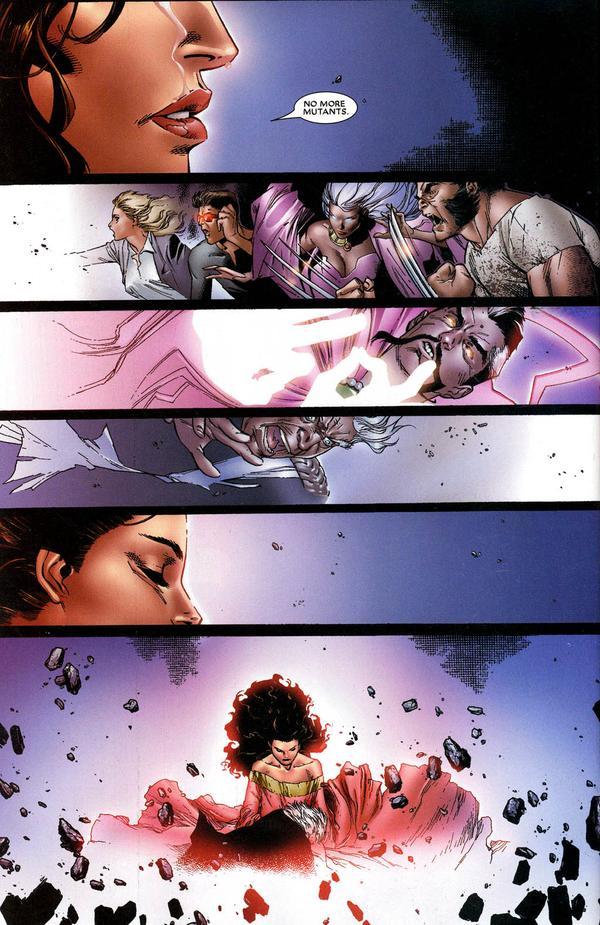
While "House of M" largely took place in a fantasy world, it was a reflection of each characters desire. At at the heart of it was Wanda making the wish of her father come true. Seeing this fantasy crash down around her and everyone she loved drove her to finally snap and take away mutant power from the universe. It absolutely earns this page:


Essentially, the consequences at the end of the event aren't enough. We have to be able understand and come to terms with those consequences by reading the event in its entirety.

And finally -- and this is where "Avengers Vs. X-Men" creates a whole new definition of failure -- the event needs to have a singular vision and style. "House of M" was drawn by Olivier Coipel and written by Brian Michael Bendis. Bendis also wrote "Secret Invasion" and "Dark Reign". "Civil War" was drawn by Steve McNiven and written by Mark Millar.

Historically, Marvel tends to have its events written and drawn by the same team. DC tends to be more collaborative with the art, but they still tend to stick to one writer.

Really, until AvX, we've never really had an almost entirely collaborative event before. Maybe Marvel decided that it wanted to try something new. Well, that's fine, but I hope they've realized that it doesn't fucking work.

Why AvX Fails


Now that we've covered the necessary criteria for a good event comic, let's jump right in and see where AvX goes horribly wrong.

First of all, the consequences of the event are pathetic. Xavier is dead, but so what? He's been so far removed from the X-Men franchise for the past decade or so that he might as well have been dead already. Besides, I doubt it will last. Cyclops is in prison, but once again, that probably won't make a huge difference. But no, the whole event was building up to the destruction of the Phoenix Force and the return of mutants. So really, all it did was undo "House of M".

Second of all, even with its incredibly small and inconsequential list of consequences, it failed to earn any of them. Cyclops' heel-face-turn is just plain awful. "No one but Joss Whedon knows how to make him interesting, so we'll just make him a one-dimensional bad guy and disregard his decades of growth as a character and a leader." Xavier's death does not mean anything significant other than "Cyclops is evil now" and it doesn't happen as the result of any significant change or decision. Finally, the reversal of the Decimation and the destruction of the Phoenix Force could have worked if it was the entire point of the event, but it really wasn't. The point of the event was just creating excuses to kill time and get heroes to fight each other for twelve issues. Issue #0 did a great job of establishing that maybe Hope would actually evolve as a character. But no, she basically just does what she was more or less intended to do from the beginning: absorb the Phoenix and fix the mutants. The only growth she gets is a training montage and a few speeches about how she wants to just be herself, but we never really find out who that person is.

And then, on top of the entire event being almost completely pointless, the decision to bring in four artists and  five writers was a massive bust. The tone and style is all over the place. It's difficult for an artist and a writer to work together and really GET each other. It's nigh impossible to have a different team on almost every single issue and maintain a singular style and tone that carries throughout. Yes, TV series can sometimes manage this, but they usually have a showrunner who exists in order to give the series a consistent tone and vision.

My guess is that either AvX was written by committee with no singular individual taking charge, or it was organized by editorial mandate. So either the problem was a lack of leadership or the leadership from someone who's more interested in the big picture and the bottom line than the actual quality of the story and consistency of the characters.

But really, these are just the technical failings of the event. There are also much more damning problems that have to do with the formula of this event.

With Friends Like These...


"Civil War" was a big deal because it pitted hero against hero. This sort of thing hadn't really happened before, at least not on a scale that massive. Both sides were understandable to a degree. The underlying question of the conflict was, "How much responsibility should be expected of the people who we consider to be heroes?" Is it right to treat the people who've saved the world more times than we can count as though they are walking time bombs? It's an interesting question and there's no clear right answer. That's what made "Civil War" compelling.

The problem is that "Civil War" was a massive success and so just about every event since then has been about pitting heroes against heroes. It's pretty clear that Marvel has been under the impression that the only thing people like better than seeing all of their heroes fight together is seeing their heroes fight each other.

Sorry, but NO. Marvel can't keep pulling this out every event. The events can't just be excuses to get heroes to fight each other. That's just... tacky.

And I'm not saying that heroes CAN'T fight each other in an event comic. I'm just saying that the underlying conflict has to be compelling. It can't just exist for the sake of creating excuses to fight.

And really, that's all that AvX is. One big excuse to have characters fighting each other. I mean, it's the fucking title of the event. And what is the big central conflict? The Avengers are worried about the Phoenix and what it might do to Hope and the rest of the world. The X-Men overreact and refuse to cooperate. So then they fight.

The basis of the ENTIRE CONFLICT is fear of what MIGHT happen and neither side wanting to trust the other. That's it.

I'm sorry, but conflict predicated on heroes being assholes to each other is not interesting. Hell, even the conflict in "Secret Invasion" pulled this off better simply because the nature of the attack was designed to create fear and distrust and it came right on the heels of "Civil War", so they were still pissed at each other. In this case, the only reason the Avengers and the X-Men fight is because Marvel can't make a 12-issue miniseries and a fuck-ton of tie-in comics based around a matter that can be easily talked out.

The other problem is that unlike "Civil War", there's always a particular side that's blatantly in the wrong. For the first half, the Avengers are demanding to take an innocent girl into custody by any means necessary. They think they can stop the Phoenix. They're obviously wrong. Their attempt to stop the Phoenix cause the X-Men to take in the power. At which point, the X-Men are in the wrong because they are corrupted by the power.

So basically the event can be summed up as, "Everyone was an asshole. The End."

And more importantly, the conflict has no direct relation to the central point of the story, which is to finally end the Decimation and get rid of the Phoenix Force. The only conflict that should be present is the conflict between mutants and the rest of the Marvel superhero community. And yes, AvX TRIES to do this, but it fails.

It is an interesting point of contention that the mutants are treated differently from the rest of the superhero community, and that could have been explored. We could have had a conflict that took shape in some way other than a massive battle royale. The Avengers and X-Men could have agreed to put aside their differences and try to put a stop to the Phoenix Force. Obviously, they would fail, and then the Phoenix Force could put an end to the Decimation. In other words, the event should have started with where it ended up and then explored the consequences of the sudden reversal of the Decimation. I mean, the mutant community has been backed into a corner for the better part of a decade now and their sudden resurgence would definitely shift the weight of the superhero community. The superheroes have only just recently been regaining public favor after the double-fiasco of "Civil War" and "Secret Invasion", and to have the "mutant menace" suddenly jump back into the public eye could put pressure on them to get it contained. Meanwhile, the mutant community could simply ask why the rest of the superheroes could earn the trust of the public but the mutants can't. Why is it that the source of power is so important? Why are mutants more feared just because they are born with the power? Real conflict can come from that and it would have had a lot more potential than what we ended up with.

And more importantly, why does the conflict have to be directed at other heroes? The Marvel Universe has no shortage of villains, many of which could stand to get a little more exposure and development.

What Did Work


Not everything in AvX was a complete wash. If you read my individual reviews, you'd see that there were a number of issues that I really liked. I think that overall, the writing is rather good. Except for Romita, all of the artists do work that ranges from good to excellent. Taken individually, some of the issues work rather well. The event simply doesn't work as a whole.

I did appreciate that Marvel didn't flood the comics with splash pages of hundreds of heroes fighting each other like "Civil War" and "Secret Invasion" did. It was smart enough to keep all the big brawls contained in their own tie-in series. It also didn't put in too many Editor's Notes. That is to say, there are few moments where they shamelessly plug tie-in comics saying, "Find out what this character is talking about in THIS COMIC". They managed to make this story complete and self-contained. From a logistic and marketing perspective, this series was well-organized.

Moving Forward


So in an effort to try and replicate DC's success with their New 52 relaunch, Marvel is gearing up for "Marvel NOW!", which is a relaunch in the sense that they are restarting most of their series and shifting around their writers and artists, but they aren't relaunching the continuity. AvX is kind of designed to lead up into that relaunch, but it kind of doesn't. Like I said, nothing major changes. Cap decides to create ANOTHER new Avengers team, this time the Uncanny Avengers which will add more mutants to the roster, but that's about all that AvX establishes.

Really, I find myself incredibly underwhelmed with the direction of the Marvel Universe in the comics. Out of the 15 new series they're launching right away as a part of the "Marvel NOW!" relaunch, only 5 are solo titles. The rest are team-up books, and with the exception of the Fantastic Four and the Thunderbolts, they're all tied in some way to either the Avengers or the X-Men. "Uncanny Avengers", "All-New X-Men", "Avengers", "New Avengers", "A+X", "X-Men Legacy", "Avengers Arena", "Cable and X-Force", and "Uncanny X-Force". I mean, seriously? I'm a fucking comic fan and even I don't know where the fuck to start with this mess. Do we REALLY need this many teams? As a point of contrast, out of all the series introduced during DC's New 52, less than half are team books. DC has more solo titles than Marvel's upcoming individual titles put together. I know not all of them are any good and DC has problems of its own, but at least we get variety. If you don't give a crap about the Avengers or the X-Men, you have a very small list of characters to choose from. DC on the other hand has something for everyone. Horror, magic, fantasy, science, mystery, distant future, AND twenty different flavors of Batman. It's damn near impossible to find NOTHING that appeals to you.

And on top of that, the whole point of a relaunch is to give new readers a point to jump on. A new series that can be explained within a few pages or at most an issue. No excess baggage or cumbersome continuity littered with Editor's Notes. But if 2/3 of the relaunched/new series are all spin-offs of either the Avengers or the X-Men, then you kind of defeat the purpose. By making them spin-offs, they are inherently FILLED with baggage and continuity. If I don't know what the hell is going on with the X-Men or the Avengers, then how the hell am I supposed to jump into these new titles? Just giving them new titles, new creative teams and the #1 on the cover isn't enough to make them accessible. 

Say a new reader walks into a comic store. They just finished watching "The Avengers" on Blu-ray for the fiftieth time and so they decide that they want to check out the comics. Oh look! An "Avengers" title! A #1 issue! Perfect! ...Wait, what's "Uncanny Avengers"? Huh? "New Avengers"? "Avengers Assemble"? What? Why are there so many Avengers? Which one's the real team? Are they all real? I don't want to buy ALL of them. Maybe I should just get that "Avengers" one. That's probably the real one. See, it has Hulk, Iron Man, Cap, and Thor. It has to be the right one. But wait, "Uncanny Avengers" also has Hulk, Iron Man, Cap, and Thor. How can they be on both teams? Oh God. "Avengers Assemble" ALSO has Hulk, Iron Man, and Thor. Fuck this shit. Comics are weird.

Based solely on where the universe is at the end of AvX, I don't really think I care enough to jump onto any new Marvel comics. I'll check out the new "Deadpool" series and I'll keep my ear to the ground in case any of the new series get a ton of praise, but really, AvX didn't really make me want to find out what happens next. The only change that happened in Iron Man was that he became more spiritual. Cap was pretty much out of character throughout the entire event. Hulk has had less consistent character growth than just about any other character in the universe. Every new writer just basically does the same thing over and over and whenever someone changes something, the next writer just goes back to basics. I never really liked the Fantastic Four much and I really don't like Fraction. I don't have the slightest fucking clue what's been going on with Thor, and if "Fear Itself" is any indication, I don't really want to.

Never before has an event made me actually give LESS of a crap about the Marvel Universe than I did before I started reading it.

I know there's still some Marvel NOW! titles that haven't been fully announced yet that will come out in a few months. I'm sure we'll get more variety when that happens. But I guarantee that with the exception of a probable Guardians of the Galaxy title, they'll probably almost all be variations on X-Men and Avengers.

At least they aren't canceling "Captain Marvel", which I still enjoy quite a bit.

It really does baffle me that Marvel can be so good at managing its movie franchises and yet so completely inept at managing their comic book series.

But back to my original point. Probably the biggest problem with the Marvel Universe is that just about every single character is either an Avenger or an X-Something. The original idea of the Avengers and the X-Men was that they were somewhat exclusive. Only the best superheroes could be an Avenger and only the best mutants could be an X-Man. Now it's weird if you AREN'T in some version of these two teams. The fact that you can include virtually every major Marvel superhero in an event about Avengers fighting X-Men goes to show that MAYBE they need to reclaim their brands a little. Stop putting their popular characters on every team. Wolverine, Spider-Man, Iron Man, Hulk, Thor, and Cap can't be on every damn team AND have their own solo titles. Let some of the other characters get a chance to shine. Make each team distinctive.

Seriously, Marvel. Get your shit together.

Thursday, August 16, 2012

My Pull List - Comic Reviews for 8/15/2012

- Avengers Vs. X-Men #10
- Captain Marvel #2
- Deadpool #59
- Deadpool Kills The Marvel Universe #3
- Green Lantern #12

SPOILERS beyond this point.


Tuesday, August 7, 2012

Marvel Cinematic Universe: The Bottle-Neck

As I had mentioned in a previous post, there's a good chance that Fox doesn't have enough time to make their "Daredevil" reboot before the rights revert back to Marvel Studios/Disney.

However, yesterday there was a moment where it appeared that Marvel had done something unexpected and rather brilliant. They supposedly offered Fox an extension on "Daredevil" in exchange for some of the cosmic characters from "Fantastic Four". Unfortunately, it appears that Fox isn't biting, but in this moment, something that had been nagging at me for quite a while regarding the Marvel Cinematic Universe came to the forefront.

After the massive success of "The Avengers", a lot of people expressed concern regarding whether or not Marvel Studios had anywhere to go but down. I'm not in that camp. I thought "The Avengers" was a great movie that provided everything we were expecting, but it certainly wasn't an insurmountable success. I loved it, but it was by no means a perfect movie. Much like "The Dark Knight Rises", nothing really reached me deep down on a visceral level and kept me thinking after I left the theater. Unlike TDKR, however, it didn't need to. "The Avengers" did something unprecedented and it did it very competently and with its own unique style. It succeeded because it is greater than the sum of its parts and it exists as a proof of concept for a new age of superhero movies. As much as I enjoy it, I won't be surprised if the next Avengers film surpasses it. Perhaps not in a financial sense, but definitely in terms of quality. Now that we've established that this sort of film is possible, they can start raising the bar in terms of plot and character.

That being said, there was one major concern I had regarding the Marvel Cinematic Universe and with this recent "Daredevil" debacle, I think it's actually a pretty serious problem.

Marvel Studios is only going to be putting out one or two movies a year, but they have more characters than they know what to do with.

I mean, let's look at what we've got down the pipeline. We've got "Iron Man 3", "Captain America: The Winter Soldier", "Thor: The Dark World", "Ant-Man", "Guardians of the Galaxy", and "Avengers 2". This would presumably carry us through 2016. That's four years from now. Unless they start dabbling in other forms of media as well, this is all we're getting for the next half-decade.

Meanwhile fans are clamoring for movies about Black Panther, Doctor Strange, Punisher, Iron Fist, etc. as well as asking for solo films for Black Widow, Hawkeye, Nick Fury, and Ruffalo's Hulk.

The hard truth of the matter is that Marvel Studios can only make so many movies, they definitely don't want to saturate the market by releasing too many movies in any given year, and they also want to focus on their established characters (Iron Man, Thor, Cap) so the majority of these characters will probably only show up as supporting characters if at all.

This is not really a BAD problem to have. It's good that Marvel Studios has so many options in terms of which characters to explore and can take their time to make their choices carefully without flooding the universe much like they do with their comic universe. The problem is just that while it would be great for Marvel to get the rights to Daredevil back, it would likely mean we wouldn't get another Daredevil solo film for a long, long time, if ever. He could theoretically show up in some capacity in other films, but that would be about it.

So frankly, Marvel made the smartest possible move when they tried to trade Daredevil in for Galactus and Silver Surfer. Those characters are really handy to have around, especially now that they're getting into the cosmic stuff. And now that Fox has apparently turned down the offer, even though I know that Daredevil is 90% sure to be returning to Marvel now, I can't help but feel a little disappointed.

Maybe things will change after "Avengers 2". Maybe Marvel Studios will have started making enough money that they can afford to produce three movies each year and the bottle-neck will be less inconvenient. Maybe they'll start licensing their properties out again but with stipulations that the characters have to remain in-continuity (though I'm not sure how many studios would agree to that). Maybe they will start making television shows that tie into the universe and give us a chance to explore more of the lesser-known characters and act as a sort of spring-board for the feature films. They are still looking to make a Hulk TV show with Guillermo Del Toro, but it sounds like it probably wouldn't be in-continuity. They looked at maybe doing a show about Jessica Jones which would have been in-continuity, but it didn't get picked up.

Right now, I think the biggest problem the Marvel Cinematic Universe has to face is the fact that they can only expand the universe at a rate of about 4-5 hours per year, and I think that will get pretty frustrating. Maybe not right now, but if SDCC 2016 rolls around and Marvel doesn't announce a solo film for Doctor Strange in Phase 3, I'm going to be pissed.