Now, I'm not here to talk about why these old people don't matter. Whether or not they think LoL or DOTA2 or any other MOBA counts as a sport matters about as much as it did when Roger Ebert said that games can't be art. Yes, it might be maddening and inspire us to rant and rave about this or that, but it won't really change anything. MOBA championships will still continue to be increasingly popular and other video game championships will likely join the ranks and no one will care whether or not old sports journalists consider it to be a legitimate sport.
But it does make me wonder... are MOBAs sports? I mean, it probably doesn't really matter, but I like to ponder these things anyway because the MOBA genre is interesting to me and I haven't really talked much about them before.
What's a MOBA?
MOBA stands for "multiplayer online battle arena". Not very helpful, I know, but it's a relatively new-ish video game genre that started out as an off-shoot of real-time strategy games like "Starcraft" or "Warcraft". The primary difference being that instead of setting up buildings and micromanaging soldiers, you primarily only concerned yourself with one character and all of the buildings and soldiers were mostly out of your control. All you had to do was defend your own team's buildings while destroying your opponents. You mostly did this by leveling up over the course of the game, gaining power, and buying new items.
Matches are played in real-time between 5 players on a symmetrical map. The first team to destroy their opponent's primary structure at the opposite end of the map, wins. That's pretty much the main focus of the game, but if you want to know more, just Google it or play "League of Legends" or "DOTA 2". You can play both games for free.
While there are sometimes modified ways of playing (one-on-one, different rulesets, etc.) the primary game is played 5-versus-5 in the way I just described, and almost everyone plays in this way.
"It's Not a Sport, It's a Game"
Probably the second-most nerd-rage-inducing comment from the video above (the first would be the "Star Trek" comment) would be the quote, "It's not a sport, it's a game."
This distinction is left undefined, but it's one that modern humanity has debated for quite a while.
For example, in order to be a part of the Olympics, technically all an activity needs to qualify is to be sanctioned by an international sport federation. Chess is such an activity, yet it is unlikely to ever be included in the Olympics, nor is it probably ever going to be considered a sport.
There is one obvious answer: The difference between a game and a sport is that a sport requires strenuous physical activity.
This seems fair, but it's not always applicable. Archery, for example, does not require a great deal of physical strength, relying far more on precision and coordination. Equestrian sports depend little on the physical acumen of the rider, depending far more on the horse.
Well then one might say that those sports still require physical precision and practice. That muscle memory and physical training are still a required component. You certainly can't say the same about chess.
And that seems fair, but if we are merely talking about some kind of physical demand, MOBAs certainly fit that bill.
Almost all high-level players utilize lightning-quick reflexes, precise timing, and complicated maneuvers that require a great deal of practice and training. While not necessarily physically demanding, muscle memory and coordination are as key to professional MOBA playing as they are to archery or golf.
The problem then is that you could then potentially call "Guitar Hero" a sport. It does, after all, require a lot of physical coordination and muscle memory, perhaps more so than MOBAs. And in that regard, why aren't real musicians considered athletes? Drumming is far more physically exhausting than golf.
Well, for starters, you can't objectively measure standard music playing. Music is an art and its quality is nearly impossible to quantify in an unbiased way. While ice dancing can be argued similarly, judges often rate performances based on very specific criteria.
OK, that explains why real musicians aren't in the Olympics, but what about "Guitar Hero" or "Rock Band" or "Dance Dance Revolution"? Those games are scored.
Well, to get into why MOBAs could be considered a sport in a way that "Guitar Hero" cannot, we'll have to talk more about MOBAs in general.
The Court
Even though it's scored, there's a reason why competitive rhythm game competitions never really caught on. The result of a competitive match often depends on what song you pick.
I played in a few small competitions for rhythm games when I was a bit younger and the competition format was always very haphazard. There was really no fair way to do it. No one was equally good at every song. There were some matches when I defeated someone far better than me because we were playing on a song that I knew really well. I think I technically missed more notes, but because I knew when to use Star Power most effectively, I still won. That wasn't because I was a better player, it was because I just happened to know that song really well. I could just as easily been given a different song and lost.
This applies to games like "Halo" as well. The format varies from tournament to tournament. Maybe they choose a different map or a different set of rules. There's too much potential variety.
Whereas if you play a game of basketball, it doesn't necessarily matter where you play. Yes, different courts might have different subtleties about them and different referees might be stricter about certain things, but the structure is the same. The rules are the same. The court is essentially the same.
Most video games don't really have just one "court". "Call of Duty" wouldn't be half as popular if it only had one map. And the map of one online shooter is going to be vastly different from another online shooter.
But when it comes to MOBAs, there's really only one format. One primary way to play.
And the interesting thing is, this isn't just individual to each game. The overall goals and mechanics of DOTA2 are more-or-less identical to LoL. Just about every MOBA game has the same "court":
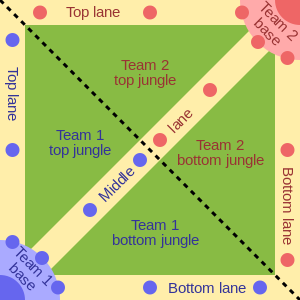
You have 2 bases, 3 lanes, 22 towers, 6 inhibitors/barracks. The intricacies may change between games, but the overall mechanics of a MOBA are basically the same no matter which one you play.
The big difference between MOBAs are the characters. Most popular MOBAs have very large rosters of characters, each with their own unique power sets. There are very few characters that can be identified as particularly "strong" or "weak" because it's all relative to what characters are popular at the time. If one character is popular because of a certain ability, other characters that are good at countering those abilities tend to become more popular while those more susceptible to those abilities become less popular. Then if another type of character becomes popular or if new characters are added or existing character mechanics are modified, things start shifting.
This isn't all that different from how actual sports work.
Let's look at basketball again. In the decades we've been playing it, the way its played has changed a lot, but not because the rules have changed, but because the people playing it have changed the "metagame".
There's another reason why MOBAs work more as a sport than most other video games, and it actually is tied in with the court aspect.
Spectators
Part of what makes a sport a sport is less the game itself and more the community around it. Plenty of sports have been invented, but if you can't get a crowd to show up and watch them, no one will ever care.
"Call of Duty" multiplayer requires a lot of skill, strategy, and physical precision, at least as much as any MOBA does, but as a spectator sport, it's far inferior, and that's because the spectator is rarely given an omnipresent view of the situation, and if they are given one, it is separate from the view given to the players.
Imagine watching a game of football entirely through the perspectives of the players. You'd never really understand what was going on. The player, on the other hand, has the ability to understand pretty much the whole big picture because of the way the field is laid out. They can pretty much see any part of the field at any time they want, though they of course have to pay attention to what's right in front of them as well.
In a shooter, even if you did watch the game from a top-down perspective, it's an experience entirely divorced from what the player is experiencing.
But the way a MOBA is structured makes it function in a way not dissimilar to other spectator sports. The spectator gets the same top-down view that the players have. The players can't necessarily see EVERYTHING due to fog of war, but they can get an idea of the big picture. However, like a football player, it behooves them to get an impression of the big picture as often as possible while still focusing on what's in front of them. Also, one thing that I find fun about watching MOBAs is that some of them allow the spectator to focus on whatever they like. They can see it from the perspective of a player or just look at a general area. The viewer gets to absorb the game as a whole rather than focus solely on one part of it that they can't control.
The one big problem with MOBAs as a spectator sport is fairly obvious to anyone who tries to watch a MOBA game without having played one. It can be confusing.
There are so many characters and abilities and items and strategies that the amount of lingo in a MOBA can be staggering. While this is true about a lot of sports, most sports have a baseline of understanding that can give a new spectator a tenuous grasp on how the game is going. Specifically, a score. When I didn't really understand the rules of football, I could at least understand that bringing the ball to the end of the field was a good thing and that the team with the most points won. I could tell who was winning and I could tell when something good happened for one team when their score went up. If something they did caused the score to go up more, I got the impression that it was a good thing to do.
MOBAs often lack that baseline appeal. Part of what makes a MOBA exciting is that the tide can be turned at almost any point in the game. While most matches are decided very early in the game during the laning phase, a really good jungler or a well-organized team can still pull out a victory if they play their cards right. But it means that it's hard to really grasp something as simple as "who's winning?"
You could get a vague idea of who's winning based on which team has destroyed more towers or which team has farmed more experience and gold or which team has died fewer times, but while those aspects of the game influence the outcome, they don't decide it. Until a base is destroyed, anyone could win.
Chess has a similar problem. While there is a point system to chess that could be used to suggest someone is winning, that's not what decides the game. Until someone has delivered a checkmate, it could be anyone's game. Still, people who walk by while you're playing may still simply ask "who's winning" because unless you play a lot of chess, it's hard to really know who has who on the ropes.
That's kind of the biggest problem with MOBAs as a spectator sport. However, as the video at the beginning of this post points out, MOBAs certainly aren't lacking for spectators.
So why is that? Why do so many people come out for MOBA tournaments than pretty much any other kind? Well, I think there are three main reasons.
First, MOBAs are really popular right now. Thanks to the free-to-play model and the dedicated fanbase for real-time strategy games that built the MOBA genre, MOBAs are played by a lot of people. So naturally, there are a lot of people who understand the games enough to enjoy spectating.
Second, as I already mentioned, MOBAs have the "court" structure which makes them easier to watch than most other competitive games. Fighting games come close, but the problem with fighting games is that the characters aren't different enough to really make a compelling and perpetually evolving metagame. It's why they have to keep making new versions of fighting games every few years. If you just add new characters to an existing fighting game, it throws the whole roster out of balance because while each character has their own special strength and abilities, the basic mechanics of each character are easily compared. At the end of the day, every character kicks, punches, and has some kind of mega-move. But MOBAs tend to deal more with what Extra Credits calls "incomparables" (more on that here if you're interested) where the abilities of one character can be wildly different when compared to another character, particularly when you also have to take into account how they interact with the other members of their team. Even fighting games that allow you to tag out multiple characters and have dozens of characters to choose from like "Marvel Vs. Capcom" tend to gravitate towards a handful of characters that fit particular play-style niches that have developed in the fighting game community over the years. Meanwhile, MOBAs are free to fundamentally alter their entire metagame simply by introducing an innovative new character into the system.
Lastly, even if you don't really understand what exactly is happening, a MOBA is visually interesting. Complex without being too crowded and alienating. When something cool happens in a game, even if a spectator has no clear idea of what exactly is happening and why it matters, they can still tell that it's cool. For example:
You might have no idea what the announcer is talking about. You might have no idea what exactly just happened. You might have no idea why it matters. But in a way, you don't really need to. What did you see? You saw a bunch of those guys with red bars team up and ambush the team with green bars, sucking them into a black hole, but then the green guys dispelled it, sucked them into a black hole, and killed all of them. You don't have to know much to know that "killing all of your opponents at once while being ambushed" is pretty damn cool.
Because all MOBAs have the same basic setup and maps and the only variety is in the characters and the players, you have a game that can be played in virtually infinitely-many ways while still maintaining the basic setup and structure as a point of reference. Everything is built-upon rather than discarded and rebuilt from scratch.
The one big problem with MOBAs as a spectator sport is fairly obvious to anyone who tries to watch a MOBA game without having played one. It can be confusing.
There are so many characters and abilities and items and strategies that the amount of lingo in a MOBA can be staggering. While this is true about a lot of sports, most sports have a baseline of understanding that can give a new spectator a tenuous grasp on how the game is going. Specifically, a score. When I didn't really understand the rules of football, I could at least understand that bringing the ball to the end of the field was a good thing and that the team with the most points won. I could tell who was winning and I could tell when something good happened for one team when their score went up. If something they did caused the score to go up more, I got the impression that it was a good thing to do.
MOBAs often lack that baseline appeal. Part of what makes a MOBA exciting is that the tide can be turned at almost any point in the game. While most matches are decided very early in the game during the laning phase, a really good jungler or a well-organized team can still pull out a victory if they play their cards right. But it means that it's hard to really grasp something as simple as "who's winning?"
You could get a vague idea of who's winning based on which team has destroyed more towers or which team has farmed more experience and gold or which team has died fewer times, but while those aspects of the game influence the outcome, they don't decide it. Until a base is destroyed, anyone could win.
Chess has a similar problem. While there is a point system to chess that could be used to suggest someone is winning, that's not what decides the game. Until someone has delivered a checkmate, it could be anyone's game. Still, people who walk by while you're playing may still simply ask "who's winning" because unless you play a lot of chess, it's hard to really know who has who on the ropes.
That's kind of the biggest problem with MOBAs as a spectator sport. However, as the video at the beginning of this post points out, MOBAs certainly aren't lacking for spectators.
So why is that? Why do so many people come out for MOBA tournaments than pretty much any other kind? Well, I think there are three main reasons.
First, MOBAs are really popular right now. Thanks to the free-to-play model and the dedicated fanbase for real-time strategy games that built the MOBA genre, MOBAs are played by a lot of people. So naturally, there are a lot of people who understand the games enough to enjoy spectating.
Second, as I already mentioned, MOBAs have the "court" structure which makes them easier to watch than most other competitive games. Fighting games come close, but the problem with fighting games is that the characters aren't different enough to really make a compelling and perpetually evolving metagame. It's why they have to keep making new versions of fighting games every few years. If you just add new characters to an existing fighting game, it throws the whole roster out of balance because while each character has their own special strength and abilities, the basic mechanics of each character are easily compared. At the end of the day, every character kicks, punches, and has some kind of mega-move. But MOBAs tend to deal more with what Extra Credits calls "incomparables" (more on that here if you're interested) where the abilities of one character can be wildly different when compared to another character, particularly when you also have to take into account how they interact with the other members of their team. Even fighting games that allow you to tag out multiple characters and have dozens of characters to choose from like "Marvel Vs. Capcom" tend to gravitate towards a handful of characters that fit particular play-style niches that have developed in the fighting game community over the years. Meanwhile, MOBAs are free to fundamentally alter their entire metagame simply by introducing an innovative new character into the system.
Lastly, even if you don't really understand what exactly is happening, a MOBA is visually interesting. Complex without being too crowded and alienating. When something cool happens in a game, even if a spectator has no clear idea of what exactly is happening and why it matters, they can still tell that it's cool. For example:
You might have no idea what the announcer is talking about. You might have no idea what exactly just happened. You might have no idea why it matters. But in a way, you don't really need to. What did you see? You saw a bunch of those guys with red bars team up and ambush the team with green bars, sucking them into a black hole, but then the green guys dispelled it, sucked them into a black hole, and killed all of them. You don't have to know much to know that "killing all of your opponents at once while being ambushed" is pretty damn cool.
Because all MOBAs have the same basic setup and maps and the only variety is in the characters and the players, you have a game that can be played in virtually infinitely-many ways while still maintaining the basic setup and structure as a point of reference. Everything is built-upon rather than discarded and rebuilt from scratch.
Are MOBAs Sports, Or What?
Up until now, I've kind of been dancing around whether or not I think MOBAs count as sports. Instead, I've mostly been effectively talking about why MOBAs seem the most sport-like out of any other game. Why they draw the biggest crowds. Why the champions seem far more impressive. Why they are the most fun to watch. Why people argue for them being sports more than just about any other games out there.
But really, what does it boil down to? What feels so sport-like about MOBAs?
I could cheat and say "the only thing that makes a sport a sport is whether or not a majority of people consider it a sport", but I don't think that's true. I think there's something more fundamentally intrinsic to sports that make them stand out. And I think it's the idea of a game around a game.
I'm not talking about the metagame, although that's certainly part of it. I'm talking about the narrative of a sport.
I was never really into sports growing up and I still pretty much don't care all that much, but I was often confused as to why some people got into it as much as they did. Why they cared so much about teams that didn't even represent their own hometown or state, why they wore the jerseys of players, why they constructed and competed with fantasy teams. Eventually, I realized that the answer to my question was basically the question itself. People care because people care.
A simple game of American football is exactly that. A game. But there's more going on than just that game. There's a metagame being played by the managers and coaches where they decide what new players to add to the team and which old players to trade or retire. Every new season, fans watch closely to decide whether the changes have made their favorite team better or worse. It makes them grow attached to individual players, particularly if they have interesting life stories.
Just look at fantasy football. It's a game built around the idea of managing a game, not playing it. And it's insanely popular. It's because that's really the part that people love about American football. American football as a game is actually pretty boring. It's slow-paced, scored in a bizarre manner, and has a lot of weird rules that are hard to explain. But as a sport, it's deep, engaging, and ever-changing. I don't really care for it, but I understand why people get so wrapped up in it.
In order for a game to be elevated to a sport, a single game has to mean more than "just a game". The outcome of every individual game has to build to a greater whole. Each victory and loss has to matter. Each player (and in the context of MOBAs, character) has to be evaluated and have their own story.
And while it's still rather underground and mostly niche, MOBAs are starting to develop that. The ever-evolving rosters of the games change strategies every year in the same way new draft picks can change an entire season of American football. Teams are starting to forge identities of their own with star players with ambitions, dreams, rivalries, signature styles and strategies. In a way, playing a MOBA while tangentially aware of the high-level strategies being employed by the pros influences the play-styles and character choices of the more casual players.
Also, there really isn't a sport quite like a MOBA that currently exists, and for that matter, there really can't be. A fighting game or a shooter can be just as easily represented in real life, albeit with some limitations, but the core gameplay would be there. Why watch a video game of two fighters when you could watch a boxing match? Why watch a CoD game when you could watch or play a game of paintball or laser tag? But a MOBA can't really be represented in real life. You can't represent the complex power sets or the respawn times or the farming or the murdering. It can really only be represented digitally. Even just the basic goal of "destroy a base" can't be represented accurately in real life.
So I think out of all video games, MOBAs are kind of poised the most to actually thrive in the competitive community at this point. So long as the core gameplay remains the same and the crowds keep getting larger and the coverage gets better and the characters keep shuffling, I think it can stand the test of time. Maybe not the games themselves, but unlike fighting games, the individuals MOBAs don't matter as much as the universality of the game mechanics. So long as the court never fundamentally changes, the crowds will just keep growing.

