If you haven't heard, Konami announced that Hideo Kojima (mostly known for the creator of the "Metal Gear" franchise) would be teaming up with filmmaker Guillermo Del Toro (of late known for "Pan's Labyrinth" and "Pacific Rim") and actor Norman Reedus (known for his acting work in "The Walking Dead" as Daryl) to make the next game in the "Silent Hill" franchise, dubbed "Silent Hills".
I had heard this news last week and it sounded great to me, but I was rather busy last week, so I missed the other more interesting part of the story.
As it turns out, this announcement was not made at a press conference or an exclusive report or anything like that.
It was made through an enigmatic playable demo called "P.T.", or "Playable Teaser". While the teaser itself was announced at Gamescom last week and then subsequently released for free on PS4, its connection to "Silent Hill", Kojima, Del Toro, or Reedus was held back until players reached the end of the demo, at which point the initial teaser trailer was revealed.
This is a rather ingenious bit of marketing on its own, but what made it better was that the very last puzzle of the game demo was so difficult (you had to find a bunch of impossibly-hidden pieces of a picture, have a headset plugged into your controller, wait for two audio cues, stop moving completely for a few seconds, and then a phone rang) that it pretty much FORCED people to communicate about it online, making its buzz strong in certain circles of the internet long before its connections were even made known.
But I don't really want to talk too much about the game's marketing, because when I finally got to sit down and play "P.T." for myself... well, let's say I was a bit surprised. I was expecting something very short, something very straightforward, something that felt more like marketing rather than an actual demo.
What I got was probably the scariest game I've played since "Amnesia: Dark Descent", and I'd actually say that this game was scarier.
And it's not even a full game. It's not even really a demo because the content in the game won't even be in "Silent Hills". This is Kojima and Del Toro basically saying, "This is what we did for fun."
The mind reels at what the final product will be like.
Here's the thing. I'm not really big on horror games usually. I'm not really big on the horror genre in general. It's not so much that I don't like being scared, I just don't find being scared to be fun. Some people like getting frightened, and I understand and respect that, even if I don't count myself among them.
The problem with the majority of games and films in the horror genre is that they operate on the assumption that their audience just wants to be scared and that as long as they accomplish that, they're good to go. It's the same kind of lazy thinking that leads to action films where the filmmakers are only interested in making stuff blow up, or films for children that only seek to stimulate rather than engage young viewers. In order for me to be interested in watching a horror film, it has to be a good movie. It has to use fear for something other than a cheap thrill. And similarly, a video game in the horror genre has to be a good game for me to even consider playing it.
"Silent Hill" has been one of the few horror franchises I've dipped my toe into because when it's done well, it understands that horror is about more than just sudden loud noises and things jumping out at you from around the corner. It's about getting inside the player's head. Making them feel something other than just a pounding heartbeat.
However, since "Silent Hill" has left Japan to be produced by Americans and Europeans in recent years, it has generally lacked the same subtlety and balance the original four games tried to have. I admit I haven't played a number of these games, but it's fairly clear that none of these games have quite hit the mark. The game I thought came closest was "Shattered Memories", but while it managed to have improved gameplay and actually tried to focus on psychological scares rather than random jump scares, it... well, it wasn't very scary. The monsters weren't very interesting and didn't really reflect any deep psychological issues being dealt with in the story, the transition to the Otherworld segments was too telegraphed to provide any significant stress during the rest of the game (if the walls aren't made of ice, you can relax), and while the story was interesting, it didn't really deal with anything particularly difficult. It was just about daddy issues, and while it was interesting, it didn't have the same emotional punch some of the more successful "Silent Hill" games have had.
So when I played through "P.T." and got a glimpse of what Kojima and Del Toro had in store for us... I definitely think they get it.
When it comes to horror in video games, I believe it holds a power greater than horror in film. In a film, you can turn away, close your eyes, curl up, and wait for it to be over. You can't play a video game with your eyes closed (well, not typically anyway). In film, you holler at the protagonist to not open that door or to turn around and go home. In a video game, YOU are the one choosing to open the door and walk forward. Video games have all the visual and audible power of a film when it comes to horror, but they have the added benefit of making the player choose to keep going.
"P.T." does this beautifully.
First of all, the space in this game is incredibly small. You start in a room with a door. You walk through the door into a hallway. The hallway has a little nook with a clock and a plant. At the end of the hallway is a corner turning right. In that corner is a small counter with some pictures and food wrappers and other assorted junk strewn about. Then you turn to corner to another hallway. In this hallway, there's a door to your right leading to a bathroom. Further down the hallways is the foyer with another counter with more pictures and a radio and a door leading outside (that is, of course, locked) and another door further along the hallway. This door leads down a staircase to another door. Through that door... is the first hallway again with the clock and the plant.
This is the entire game space. A looping hallway. The hallway changes each time you go through it, of course. Sometimes you can't move on until you solve a puzzle, but in the end, you always just walk down the stairs and walk back out into the hallway for more.
The idea to use such limited space really evokes the original genius of the original "Silent Hill" games which utilized their limited budget and graphics capabilities by surrounding the entire town in fog. It's obvious that Kojima and company couldn't waste too much time and energy on a demo that wouldn't even be used for the final game. So they designed a simplistic scenario and turned it into an advantage.
The endlessly repeating hallway is incredibly unnerving because this game never gives you a moment to relax. You spend the entire game wanting to get out and to avoid the horrors you experience, but you just... can't. Even in some cases where you seemingly die and start over... it's just a continuation. Even death isn't an escape. It's torture, plain and simple. Your only option is to either stop playing (and forever wonder what awaited you) or simply force yourself to keep going, descending further and further down into bottomless repetition.
And that's kind of the point.
I don't want to spoil too much of the story in this game, but at the very beginning, you hear on the radio about a man who went crazy and slaughtered his family. While I don't think it's ever explicitly stated in the game, I think it's pretty damn clear that the character you play in "P.T." is the man himself. And this never-ending hallway and every single horror you face is his punishment for what he did.
But it's not enough that he be forced into a never-ending loop that he cannot escape. No, throughout the game, you can often only progress by directly confronting and acknowledging the horrible things he did, sometimes actively reenacting (at least symbolically) some of those acts. This is interesting because oftentimes, your instinct in a game like this is to avoid the scary stuff. Games like "Slender" are successful because they put the player at a conflict between wanting to find the pieces of the puzzle and wanting to avoid the horrible scary thing that they know is after them.
Part of what makes games like these work is the fact that the player goes in expecting to be scared. The choice to give this game a first-person perspective means that every corner is a potential scare. Every time you turn around, you don't know what could be lurking behind you. And even though you can get through this entire game and only experience one or two legitimate jump scares (although when I played it, I experienced five), you spend the entire time expecting them.
For example, through most of the beginning of the game, the bathroom door I mentioned is locked. After a few loops, you see it open a crack, but you can't go into it. However, the door to the stairwell is locked, so you have no choice but to explore, and that crack is all there is to explore. You can just barely make out the interior of the room. You can make out a sink... a toilet... maybe a mirror... but it's too dark. Then, without warning, a terrifying figure shows her face in the crack of the door and slams it shut. Then the door to the stairwell opens. When you loop around again, the bathroom door is still closed, but as you approach the stairwell (locked again, of course), you hear the bathroom door open behind you.
The terror this is meant to induce is transparently obvious. You know you saw SOMETHING in that bathroom. You know it was terrifying. You know you DON'T want to see it again. And yet... the stairwell is locked. You can't proceed. Sure, you could turn off the game, and I'm sure some people do, but... I couldn't. I had to know. And I knew that the only way to know would be to make the moronic decision to investigate the bathroom.
I move into the bathroom and can't really make anything out. I can tell that the woman isn't in there with me. I also see a flickering light on the floor. It's a flashlight. I don't want to pick it up. I don't want to see what's inside this bathroom. I don't want to limit my field of view to the floor, allowing something to jump up on me as I try to pick up the flashlight. So I leave the bathroom, just to make ABSOLUTELY CERTAIN that the stairwell is still locked and that picking up the flashlight is unavoidable. Of course it is, so I go back, clench my teeth, and pick up the flashlight.
The bathroom door shuts behind me. It's locked. At this point it becomes apparent... there's something in the bathroom sink. And the only way... the ONLY way I would be let out of the bathroom to continue descending deeper into the character's personal Hell is if I make him look directly at it with the flashlight. Bring it into focus so that it can't be avoided. Only once you face it will the door (slowly) open and let you proceed.
I won't tell you what it is. If you're curious, go ahead and watch a playthrough, or if you have a PS4, give the game a download.
The main reason I don't want to talk about it isn't necessarily because I want to keep it a surprise, but because some of the content of this game is PROFOUNDLY upsetting and the game has no qualms with rubbing your face in it.
The game surrounds you with upsetting and terrifying imagery and sounds and tells you that you have to solve puzzles to see more. WHO CAN SOLVE PUZZLES LIKE THIS!?!?
When you're frightened, the last thing you want to do is think logically. In this type of exploration-based puzzle game, the typical strategy is to just look around until you find the thing that's out of place, but this is exactly the kind of environment where you DON'T want to look around and explore. You just want to get to the end.
And that's the worst part. You have no idea how close you are to the end. How can you know when there's nothing to clue you in? I assumed it would be a short demo. Something minimalistic and simple that I could breeze through in about 15 minutes. It took me over an hour. Maybe two hours, I'm not sure. Each time it got worse, I thought, "It has to be over soon. How could it possibly get worse than this?" Then it kept going. It kept getting worse.
Once I got stuck in the red hallways (if you've played, you probably know what I'm talking about), I finally decided to find a walkthrough to figure out how to get through it, CONVINCED that I was in the last section of the game. NOPE. I still had about three more puzzles to solve first. At that point, I was just about ready to quit the game. "FUCK IT!" I thought. "I'm not putting myself through more of this. I'm done." But I couldn't let it go. I had to know. I knew that if I gave up, it would haunt me. That my imagination would probably be worse than the actual ending. So I forced myself to the end. And honestly, I'm glad I did, because the very last part is actually not that scary so long as you have a walkthrough handy (seriously, don't feel ashamed, you'll never figure out some of this stuff without help). Or at least, it's not as scary as what I would have imagined in my sleep that night. Once you get through it, the whole story comes together and you feel a certain sense of closure. Or at least I did.
I walked away from this game feeling like this man was paying for his crimes. The fact that I shared in his hellish torture for a few hours was certainly not an uplifting experience, but it's an experience I don't regret having. And while I certainly BELIEVE that the character I played as was the man who killed his own family getting what he deserved... since the game chooses to make this somewhat ambiguous and never truly confirms it means that I have to CHOOSE to believe that this Hell was meant for him. I don't want to believe that he merely escaped facing the horrors of his actions and left them for me to experience in his stead. And the idea that this is simply a belief tells me that how I choose to process the horrors of the world, both real and imagined, is in fact nothing more or less than a choice. And while our choices and beliefs affect the way we perceive reality, they do not, in fact, change it.
This game frightens me, but right now, what frightens me more is the realization that at some point, there will be an ENTIRE GAME made by the same people who created this little stroll through a certain pocket of Hell. I nearly lost myself trying to play through THIS. My girlfriend and I went to bed with the doors locked and knots in our stomachs. I don't know if I could handle a full-length game with this kind of intensity.
But I know that I want to. I want to see what this team is capable of when they aren't forced to constrain themselves to just one hallway.
I feel like they understand the potential of horror in games. They understand the power they can wield with it. And that is simultaneously exciting and mortifying.
"Silent Hills" could very well be the most frightening video game ever created.
Monday, August 18, 2014

Monday, June 9, 2014
Why Bill Watterson Will Probably Stay Retired
Imagine you flipped a coin, and by some miracle, that coin landed on its side. You don't know how you did it and you don't know exactly how long it will last before it finally falls over, but after waiting and waiting, you see that it will only fall over if you choose to touch it again. What would you rather do? Pick it up, knowing that you probably won't ever be able to do it again, or let it sit and keep it that way, allowing it to remain in that miraculous position for as long as you can protect it?
And yet somehow, "Calvin & Hobbes" has remained beloved nearly twenty years after it ended syndication.
There are a number of reasons for this. The biggest (and most obvious) reason is that the comics themselves are great. They're rare in that they often speak to a child-like mentality and understanding of the world, but not in a way that talks down to a child. Calvin often resorts to existential observations of adult reality, not to sound smart or smug, but to attempt to justify why he shouldn't do as the adults in his life instruct him to do. This allowed the author, Bill Watterson, to use Calvin as a sort of mouthpiece for criticism on the adult world while still somehow retaining Calvin's childishness. Even when Calvin is discussing things most children wouldn't revisit until high school or college, he still comes off as a kid, and that is a really hard thing to pull off.
But another important reason "Calvin & Hobbes" has remained so beloved over the years is because Bill Watterson ended it, and he ended it well. The final comic strip for "Calvin & Hobbes" could probably be considered one of the greatest endings to a serialized narrative in any media format ever. Just look at "The Sopranos" or "Breaking Bad". No matter how good you are, endings are really hard to pull off and generally leave a lot of fans underwhelmed. But "Calvin & Hobbes" had an ending that was both heartwarming and heartbreaking. It provided closure while still leaving us wanting more. It was beautiful and to this day I can't think of anyone who has said that they thought it was an unsatisfying conclusion to the strip.

A lot of people have wanted more "Calvin & Hobbes", or perhaps a "Calvin & Hobbes" film adaptation or something along those lines, but honestly, I don't think any true fans want more "Calvin & Hobbes". The collected works could stop a truck. I don't think we need more, particularly when it ended so well.
But what has left fans puzzled over these two decades is Bill Watterson's reclusivity. Given Watterson's bad history with the syndicates, it wasn't very surprising that he would not want to work on another comic strip, but I don't think a lot of people expected him to just drop off the map entirely. He finished "Calvin & Hobbes" in his 30's, so I think everyone expected him to produce some kind of creative work. And yet, he seemed to pull a Salinger. He would rarely, if ever, give an interview, he would almost never sign books, and his creative writing work was pretty much limited to writing forewords for a number of books about comics and cartoonists.
However, in the past year, he seemed to come out into the daylight a little bit. Last October, he did a rare interview with "Mental Floss", in February of this year, he did the poster for the documentary "Stripped", and just recently, it was revealed that he had been collaborating with Stephan Pastis, author of the current syndicated comic strip, "Pearls Before Swine".

The strips themselves are clever and amusing, though hardly anything all that remarkable, excepting of course that it marks the (brief) return of Watterson to the world of syndicated cartooning after nearly two decades.
Seeing all of this Watterson activity over the past year has led to a great deal of speculation. Some people wonder if Watterson is thinking about making a comeback. Perhaps he's considering something special for the 20th anniversary of "Calvin & Hobbes"? Is this a sign that his early retirement is almost at an end?
However, after seeing the interview and some of his other public comments regarding these recent events, I've actually gotten the exact opposite impression. I think I finally understand why Bill Watterson will probably never truly return to any major commercial creative endeavor ever again.
And it's not just the reasons you might assume. Sure, he had major problems with the merchandising and struggled with maintaining creative integrity and all that, but his work has become so sought after that pretty much anybody with half a brain would give the man whatever he wanted. Just look at what Pastis said in his blog post talking about the recent collaboration:
…He had a comic strip idea he wanted to run by me.Now if you had asked me the odds of Bill Watterson ever saying that line to me, I’d say it had about the same likelihood as Jimi Hendrix telling me he had a new guitar riff. And yes, I’m aware Hendrix is dead.So I wrote back to Bill.“Dear Bill,I will do whatever you want, including setting my hair on fire.”
Now, aside from just being hilarious, this does a nice job of explaining just how respected Watterson has become in the intervening years. And Pastis isn't exactly a nobody in the world of syndicated cartooning. "Pearls Before Swine" has been around and successful for almost as long as "Calvin & Hobbes" has been missing. And while I personally don't find his work particularly engaging, I can't deny that he is at this point a veteran of the industry and is not one to cast aside his pride so easily. And yet, here he is, completely willing to roll out the red carpet for Watterson and likening himself to a street urchin before Watterson's Michelangelo.
This is the impression Watterson left upon the world. This is the respect that people have for him. If he decided to come back, people would support him no matter what he wanted to do. If he wanted to compose a rap/polka fusion album, record labels would compete in the Hunger Games to decide who gets to sign him. They would let him do whatever the hell he wanted and they would let him sign any contract he wanted, just so that they could be allowed to sell something new with his name on it.
So no, I don't think artistic integrity has anything to do with his reluctance to create any new work, at least not at this stage.
Another reason people imagine he has remained a hermit is that he just enjoys his privacy. I think that this is probably true to an extent. Someone with Watterson's general exposure and introverted nature (and if you doubt that Watterson is an introvert, remind yourself that he spent ten years writing a comic about an outspoken and underestimated boy with an imaginary friend) probably doesn't like the fact that everything he does gets pounced on by the media and his fans like a pack of starved hyenas. Not just because he doesn't enjoy that kind of exposure, but also because he doesn't want to feel like he's exploiting his fanbase. He's been doing some painting in the intervening years, but he has never once considered putting them up for auction largely because he seems to know that if they sold well, it would be because of his name, not because of the work itself. It would seem like he's cashing in and it would devalue the work he creates in any case. Besides which, it seems his painting is more self-indulgent and less something he would even want to share in the first place (though I imagine when he passes away, his paintings will be highly sought after and showcased in a museum or something, regardless of his intent).
I do think that these two aspects contribute to his Salinger-ness, but I think that they are merely facets to a much bigger, but also simpler reason for his extended absence: After all these years, he's still on top.
I imagine that when he first went on hiatus after "Calvin & Hobbes" he probably did think he'd make some kind of comeback eventually. Maybe not to syndicated comics, but I imagine he thought he'd produce something new at some point. But I do imagine he felt the need to recharge and distance himself from the corporate nightmare he finally managed to escape from. Then, I imagine he became somewhat reclusive simply because that's just the way he is. As I said, he's an introvert.
I think he probably thought he'd fade into obscurity and be able to create something new and rebuild his notoriety from scratch when he eventually returned, allowed to create what he wanted without having to create it within the shadow of his previous work. However, that's not what happened. "Calvin & Hobbes" only became more beloved over time and his decision to step away from the spotlight only made his rare appearances that much more visible. For a while, he snuck to a local bookstore to secretly sign a few books, but when he found out they were being auctioned for ridiculous prices, he stopped. This sounds like the kind of person that wants to engage on some small level with his fans, but not get caught up in the whirlwind of celebrity.
Even so, I think rather than sour his outlook on life, he eventually came to the realization that maybe he shouldn't create anything new. I mean, why should he? A work that he was proud of and that he was able to finish the way he wanted to became regarded as a masterpiece and a sort of pinnacle for the medium. The medium itself has been slowly vanishing into a pixelated world, a world that Watterson himself does not find particularly interesting (and Pastis seems to confirm that Watterson is not particularly big on technology).
When he ended "Calvin & Hobbes", Watterson likened it to leaving the party early. Coming out of retirement at this point would be the equivalent of coming back while the party is cleaning up and people are drawing crude markings in Sharpie on the faces of people who passed out on the couch. Even if he did have anything substantial to add, what would it accomplish? He produced "Calvin & Hobbes" at the height of the syndicated comic strip and revolutionized it in his own small way. At this point, it's a service indebted to those who still buy newspapers, not really a challenging creative medium. Watterson's talent would largely be wasted on it.

And Watterson himself has no interest in moving on to the next stage in comic evolution. We will never see a Watterson webcomic. Watterson will never own a Cintiq, he'll never set up a booth at a con, and he'll never set up a Patreon (though if he did, I'm sure he'd probably break the service). Here's a bit from that Metal Floss interview where he talks about the future of comics:
Personally, I like paper and ink better than glowing pixels, but to each his own. Obviously the role of comics is changing very fast. On the one hand, I don’t think comics have ever been more widely accepted or taken as seriously as they are now. On the other hand, the mass media is disintegrating, and audiences are atomizing. I suspect comics will have less widespread cultural impact and make a lot less money. I’m old enough to find all this unsettling, but the world moves on. All the new media will inevitably change the look, function, and maybe even the purpose of comics, but comics are vibrant and versatile, so I think they’ll continue to find relevance one way or another. But they definitely won’t be the same as what I grew up with.So let's look at the big picture here. He's been out of the game for almost 20 years. The game itself has changed a lot in those years. The work he last produced has gone from celebrated to beloved to deified. When he does come out of his cave, even for a moment, everyone pays attention to everything he says and does. When he does feel like putting new work out into the public, he can auction it off and raise thousands of dollars for charity, largely because of the fact that his work is so rare. He maintains his hard-won privacy after all these years despite the continued popularity of his work, and he's in his mid-50's.
I imagine from his point of view, he'd have very little to gain from any further significant artistic output (and what would he want more public adoration for at this point anyway?), but he'd have everything to lose if it didn't live up to people's expectations. If he produced something mediocre, it would cost him his notoriety, it would devalue his existing work, and he would continue to get badgered by people asking him to do more work to make up for it (or to stop "ruining" his previously created works, a la George Lucas).
So really, put yourself in Watterson's shoes. What would you do?
In my mind, I imagine I'd do exactly what he's been doing. Keep to myself, enjoy the comfortable life I'd earned, keep busy with personal projects out of the public eye, and every once in a while make a small contribution to the public creative world, but on my own terms and in a way that didn't have high enough stakes to potentially jeopardize my life or creative legacy. I mean, just look at these "Pearls Before Swine" strips. Imagine if they had been hyped up beforehand. "Watterson Makes a Return This Week!" Everyone would have been going nuts, only to see the three pretty amusing strips that we got. "That was it?" Even worse, imagine if this was a "Calvin & Hobbes" comic. There would have been riots in the streets over something as average as this. But because it was announced retroactively and it was a part of something most Watterson fans generally don't have any strong opinions about one way or the other, it was just seen as a gift. A gift that we can all appreciate, not necessarily for its quality or for what it "means", but just as a nice gesture that Watterson chose to leave us.
His guest art feels like a big deal, but it works because it is small.
The only thing that I think could possibly bring Watterson out of retirement would be if he had an idea that he simply couldn't not create. Something worthy of returning to the public eye and gambling the legacy that had been built up. He is, after all, a creative person, and sometimes a creative person gets an idea in their brain that they need to express to the world or they risk losing their mind over it.
Perhaps Watterson has found that itch. Perhaps this work and his work on "Stripped" is a sign that he's been brushing up on his skills with the intent to go once more into the breach...
But I find that unlikely. I think that Watterson will still poke his head out every once in a while for the rest of his life. And maybe he will in fact do a little something for "Calvin & Hobbes" to mark the 20th anniversary. Probably something small and cute and nostalgic. Maybe an adult Calvin passing Hobbes on to a child or something. However, I sincerely doubt Watterson has any intention to create anything of particular substance.
I don't think he's crazy or resentful or selfish. I think he's a rare individual who knows to quit while he's still ahead. I know I've been beating on this one a lot, but really think about it. It's been 20 years and people are still going crazy over "Calvin & Hobbes".
Remember what I said in the beginning about the coin flip landing on its side? I figure that's how Watterson feels. At first, I figure he was probably humbled by the popularity of "Calvin & Hobbes". "Wow, isn't that cool!" But it just kept going, and now... now I imagine he sees "Calvin & Hobbes" as something else entirely.
For me, the moment when this all clicked into place was when I read that Mental Floss interview and saw this bit at the end:
Owing to spite or just a foul mood, have you ever peeled one of those stupid Calvin stickers off of a pickup truck?I figure that, long after the strip is forgotten, those decals are my ticket to immortality.
I know this bit is meant as a joke, but let's not forget, this is Bill Watterson. This man has held a very firm stance against the licensed and unlicensed commercialization of his work. And here he is, joking that those decals that represent that very thing he fought so hard to prevent were his "ticket to immortality".
I'm not entirely sure he was completely joking.
Crude and crass as they are, those decals have become a part of the popular culture zeitgeist as an extension of the overwhelming influence "Calvin & Hobbes" has had. I think the reason Bill Watterson can now have a sense of humor about these decals is because a part of him feels like he no longer truly owns "Calvin & Hobbes". Just as with the miraculous coin flip, I believe Watterson has chosen to protect this little miracle rather than to try and "own" it. And I don't expect anything will convince him otherwise.
Friday, April 4, 2014
"Captain America: The Winter Soldier" Review - When Captain America Throws His Mighty S.H.I.E.L.D.
As far as the standalone Marvel Cinematic Universe movies go, my favorite has always been "Captain America: The First Avenger". I wouldn't necessarily say it was the "best" of the standalone films, that's a judgement that's far more difficult to pass and also a far less interesting discussion (at least for me). But it was always my favorite. It felt like one part "Raiders of the Lost Arc", one part "The Dirty Dozen", and it never once tried to approach its material with irony or self-awareness. On top of that, the cast was great and diverse, the story blended seamlessly into the ever-expanding MCU with references to "Thor" and "Iron Man 2" all over the place, and it was just plain fun. It was unique, it was interesting, it was entertaining, it was bold. I loved it.
Still, I always had to give it the qualifier that it was my favorite standalone MCU movie. Obviously, "Avengers" was always my favorite in the MCU canon. How could it not be? It was smart, it was impressive, and it was indulgent in all the best ways.
So when I say that "Captain America: The Winter Solider" is my favorite MCU movie as well as the best MCU movie to date, I want it acknowledged that I say this without qualifiers. Not only do I enjoy it more than any other MCU movie to date (including "Avengers"), I would argue that it is objectively better than any other MCU movie to date (including "Avengers").
If you care at all about the Marvel Cinematic Universe, you need to see this movie. That is without question. You need to. Plain and simple. Heck, even if you don't care about the MCU, you should probably still see this movie.
That said, I don't think this movie is for everyone. For example, this movie probably wouldn't pass the Pat's Mother Test, that is to say, if my mother would fall asleep while watching it, it fails the test. A good chunk of this movie is action and intrigue and that sort of thing just bores certain people. I don't personally understand why, but some people also dislike chocolate and pizza and some people love Moxie.
If I were to try and describe this movie, I'd probably say it's like a Bourne movie if Jason Bourne fought like Tony Jaa on PCP, carried a shield, was a really good guy, and was friends with superheroes.
The fight scenes are incredible (note: I underlined that shit), the car chase scenes are some of the best I've seen since "Blues Brothers" (coincidentally, one also happens to feature a whole mess of police cars chasing the good guy), the plot is well-crafted and makes internal sense, the dialogue is never pointless and always interesting (and often funny without breaking the tone), and the movie understands the MCU continuity better than any other standalone movie since... well, since "Captain America: The First Avenger".
That's all I'm really willing to say before going into spoiler territory. If the above doesn't interest you, you might not like the movie. If you're looking for a big romance subplot or a straightforward good vs. evil story or a story where problems are solved neatly and without a lot of violence... This isn't your movie. Sorry! That said, if you tend to enjoy action films or spy films or superhero films, you need to see this movie. So go do that and join me for some SPOILERS...
Still, I always had to give it the qualifier that it was my favorite standalone MCU movie. Obviously, "Avengers" was always my favorite in the MCU canon. How could it not be? It was smart, it was impressive, and it was indulgent in all the best ways.
So when I say that "Captain America: The Winter Solider" is my favorite MCU movie as well as the best MCU movie to date, I want it acknowledged that I say this without qualifiers. Not only do I enjoy it more than any other MCU movie to date (including "Avengers"), I would argue that it is objectively better than any other MCU movie to date (including "Avengers").
If you care at all about the Marvel Cinematic Universe, you need to see this movie. That is without question. You need to. Plain and simple. Heck, even if you don't care about the MCU, you should probably still see this movie.
That said, I don't think this movie is for everyone. For example, this movie probably wouldn't pass the Pat's Mother Test, that is to say, if my mother would fall asleep while watching it, it fails the test. A good chunk of this movie is action and intrigue and that sort of thing just bores certain people. I don't personally understand why, but some people also dislike chocolate and pizza and some people love Moxie.
If I were to try and describe this movie, I'd probably say it's like a Bourne movie if Jason Bourne fought like Tony Jaa on PCP, carried a shield, was a really good guy, and was friends with superheroes.
The fight scenes are incredible (note: I underlined that shit), the car chase scenes are some of the best I've seen since "Blues Brothers" (coincidentally, one also happens to feature a whole mess of police cars chasing the good guy), the plot is well-crafted and makes internal sense, the dialogue is never pointless and always interesting (and often funny without breaking the tone), and the movie understands the MCU continuity better than any other standalone movie since... well, since "Captain America: The First Avenger".
That's all I'm really willing to say before going into spoiler territory. If the above doesn't interest you, you might not like the movie. If you're looking for a big romance subplot or a straightforward good vs. evil story or a story where problems are solved neatly and without a lot of violence... This isn't your movie. Sorry! That said, if you tend to enjoy action films or spy films or superhero films, you need to see this movie. So go do that and join me for some SPOILERS...
Thursday, February 13, 2014
Pokémon X and Y: Two Steps Forward...
I know this review is long overdue, but I just didn't feel comfortable giving the game my full assessment until the Pokémon Bank was officially released in North America, and that sadly didn't happen until very recently. I know it's technically an add-on and somewhat separate from the game, but since the release of the Bank has greatly impacted the Pokémon community since there were over 100 Pokémon previously unavailable, not to mention a large number of moves and abilities locked away as well, it seemed unwise to give my full assessment of the game until now.
First, a little backstory. I'll try to keep this brief. I've been playing Pokémon since Gen I. I haven't maintained the same level of interest my whole life, but I was there at the beginning and I'm here now. The Pokémon anime was what originally got me hooked on anime, I was crowned a Champion at the PAX Pokémon League at PAX East 2013, I have a living Pokédex entirely composed of legit Pokémon, and I own at least one game from every generation. What I say, I say from the perspective of someone who has witnessed this franchise wax and wane over the years and who still actively loves it, warts and all.

Enter Mega-Kangaskhan, one of the first banned Pokémon of the new metagame.

First, a little backstory. I'll try to keep this brief. I've been playing Pokémon since Gen I. I haven't maintained the same level of interest my whole life, but I was there at the beginning and I'm here now. The Pokémon anime was what originally got me hooked on anime, I was crowned a Champion at the PAX Pokémon League at PAX East 2013, I have a living Pokédex entirely composed of legit Pokémon, and I own at least one game from every generation. What I say, I say from the perspective of someone who has witnessed this franchise wax and wane over the years and who still actively loves it, warts and all.
Story
Let me be frank. The story for Pokémon has never been particularly engaging. That's not to say the stories haven't been well-written. I actually think the story for "X/Y" had a pretty interesting narrative with surprisingly complex characters, given the sorts of characters we've seen in the past.
But even with the story elements improving as they have, the story itself is still not even close to being engaging. This was more readily apparent in "Black/White" where the story involved what seemed to be dozens of characters, all of whom were doing far more interesting things than your character was doing, but it's still rather apparent here. The problem with the story in most Pokémon games is that the story that want to tell is not the story you're experiencing. The story you experience in "X/Y", and indeed, the story you experience in every core Pokémon game, is the story of an adolescent who gets a Pokémon, defeats a series of gym leaders, and then defeats the local Elite Four to challenge and claim the title from the Champion. There are sometimes other plots that happen in the background, such as the shenanigans of Team Rocket or what have you, but unless those plots intersect with the protagonist's journey in some meaningful way, it's just frustratingly tangential.
The problem I had with "Black/White" and to a lesser extent, "X/Y", is how whenever the background tangential narrative shows up, it grinds my narrative to a screeching halt. One or more of my stupid "friends" shows up to chat me up about how some character I don't care about is doing something off-screen that only affects characters that are also off-screen. Even if someone ends up battling me along the way, I don't care because the outcome of that battle, win or lose, doesn't impact my character's journey. If I lose to my rival, that impacts the journey because in my narrative, that character is my direct competition, the ruler by which I measure my progress. When I'm tasked with postponing my badge-hunt to fight off some bad guys in a nearby system of caves, I really couldn't give less of a crap, particularly when doing so involves multiple cutscenes where my character stands around silently while other characters talk about stuff that doesn't really concern me. "Black/White" was really bad about this in particular, where every side-quest seemed to involve every single gym leader who had to show up constantly and monologue about the same boring pointless stuff over and over again. All of this stuff was happening at me, not with me.
That's why I think my favorite game plot in the series is "Diamond/Pearl". It's roughly the same story as "Red/Blue", but with interesting twists. Your rival is your friend rather than some punk kid, and in an odd twist, he ends up failing to defeat the Champion. I actually felt a little bad for Barry when I finally surpassed him just before facing the Elite Four. Team Galactic's main focus was to summon the legendary Pokémon that you want to capture and their actions also spawn the wandering Pokémon as a result, so their actions directly impact your journey as a player. Yeah, I know that the other Teams often try to involve the legendary Pokémon du jour into their schemes, but Team Galactic's entire plan centered around those Pokémon, whereas Team Flare just used the legendary Pokémon as a power source or something.
As I said, "X/Y" isn't quite as bad as in "Black/White". At least "X/Y" doesn't contrive the story so that you save the world by defeating the Elite Four (I mean, seriously?). However, it still doesn't manage to connect the narrative in a way that doesn't feel tacked-on or frustrating for the pacing of the game.
I know some people enjoy the story, and I understand why. To those people, the point of Pokémon is the journey. When they defeat the Champion, the game is over for them. For me, the point where I defeat the Champion is where the game effectively starts. Defeating the Champion is my way of proving myself within that game, showing that I'm ready to take on whatever challenges are left in this game's world. Once I have usurped the Champion's throne, I am ready to catch 'em all, breed better Pokémon, train my A-team, and pit them against even greater foes. As such, when the story feels like it's slowing down the hero's journey rather than supplementing it, it feels like a pointless distraction to me. And sometimes the fact that these stories are completely at odds with one another is just aggravating.
For example, at a certain point in the game, you are challenged by a certified Gym Leader outside of a Gym. At first I thought this was incredible. A Gym Battle without the chance to prepare ahead of time. The pressure was on. Still, I managed to squeeze out a victory in spite of my lack of preparation and I was eager to receive my badge. Except once I win, she just walks away and tells you to challenge her again when you travel into the next town.
OK, seriously, what!? I defeated you! Yeah, you were using a Pokémon that you only just barely obtained, but that's not my fault. I'm not the Gym Leader who decides to make random challenges for kicks. If you're a Gym Leader and you challenge a Pokémon trainer to a match and you then lose, you should be expected to give them your badge. That's just how this sort of thing is supposed to work. I proved I was better than her, so she should be expected to give me proof of that. But no, that battle was just to tie into the side-plot involving the Mega Stones.
You see what I mean? That part of the game could have easily intersected with the primary motivation of the protagonist, but they deliberately decided not to because they arbitrarily decided that badges can only be earned if you beat the Leader inside the Gym. Which makes that entire battle nothing but a stupid delay to getting that Leader's badge.
I'm not saying they need to scale back the story to match the limited scope of a game like "Diamond/Pearl", I'm saying that if they want the story to be bigger, they have to jettison the traditional badge-collecting story arc. I know it sounds like blasphemy, but the story doesn't have to be about a newbie trainer climbing up the ranks to take on the Elite Four. We don't have to make badge-collection the sole driving force for the game's momentum. There are plenty of trainers in the game world who don't go around collecting badges and they seem to be the people having the fun, interesting adventures since they seem compelled to interrupt me with them every time I walk into their stupid town. Maybe make the story about a gym leader whose gym loses its certification and she has to relegitimize her status as a gym leader through a journey of self-discovery. It could be a fun way to learn how gyms come to exist and what a leader has to do to qualify.
Presentation
I don't need to spend too much time on this because this has already been gushed over for months now. "X/Y" is gorgeous, at least comparatively. No more immobile sprites, no more limited 4-directional movement, no more boring one-size-fits-all character design for the protagonist.
It's worth noting that we should have expected this kind of presentation for "Black/White", but whatever, better late than never. I'm a little disappointed that the visualized Pokémon battles are still more or less between two stationary Pokémon shooting art at one another as in the age-old "Pokémon Stadium", but it's undeniably great to see these Pokémon visualized in full CG.
I find it weird that they decided to give Pikachu the ability to say its name in-combat while still retaining everyone else's original digital cries, but here's hoping they expand this to the rest of the roster in the future.
Core Mechanics
OK, this is the part where I gush.
"X/Y" does so much with this series' mechanics, some of which I have been dying to get for years.
You can finally breed legit Pokémon with perfect IVs without manipulating the random number generator thanks to new mechanics introduced for the Destiny Knot.
Male Pokémon can pass down Hidden Abilities while breeding with Ditto.
You can battle online without having to go to a Pokémon Center.
You can save more than one battle video online and you can set up mock battles based on the Pokémon you played against (this is particularly great if you want to test out possible counters).
Berry Fields are back and streamlined to make the Berry mechanics actually kind of fun (in a "Harvest Moon" kind of way).
The new and improved Exp. Share and O-Powers have made breeding and leveling-up Pokémon so much easier. I can activate the Breeding Power and use a Magcargo to hatch four new Pokémon about every 5 minutes and the Experience Power plus the Lucky Egg plus Affection bonuses to get a Pokémon to level 50 or above through one round of the Elite Four. It's glorious.
Pokémon-Amie and the Affection mechanic, while effectively pointless outside of the main game except for a couple evolutions, is surprisingly engaging and makes me feel a bit more bonded with the Pokémon on my team. Very adorable.
Super Training has made EV training a central mechanic rather than a thing only weird people (like me) obsessed over. Also, it's made resetting EVs quite a bit easier too. Don't get why EV-training items don't work with it though. That's kind of a weird oversight.
You can search for Pokémon on the GTS even if you haven't seen them in-game yet by typing in their name. Very helpful, especially during the month or so where Japan had tons of Pokémon no one else had.
The Wonder Trade is a great way to dump Pokémon you don't want and a great way to stumble upon the occasional rare find.
The Fairy typing adds some much needed balance to Dragon Pokémon which have reigned supreme for far too long.
And of course, the Pokémon Bank, while inexcusably delayed to a ridiculous degree, is an excellent idea and a very welcome mechanic for solving the "Generation Gap" problem they'd been facing for years.
I know some people have their complaints about the Pokémon Bank. I mean, I can't deny that the Bank and Transporter are REALLY badly designed. You can only transfer Box 1 from Black/White, so every time you use Transporter, you have to open up Black/White and drag and drop every Pokémon you want to transfer into Box 1, one at a time. When you use the Transporter, it loads all of the new Pokémon into a temporary storage box and you can't transfer any more until you've emptied it completely. Oh, and once again, you have to drag and drop every single individual Pokémon from the temporary box into either your Bank or your X/Y game. And you need to have the X/Y cartridge available to use Bank. So for me, in order to transfer my living Pokédex in "Pokémon Black" to my copy of "Pokémon Y", here's what I had to go through:
Step 1) Insert "Pokémon Black"
Step 2) Open "Pokémon Transporter"
Step 3) Transfer Box 1 from "Pokémon Black" into the Bank's temporary storage
Step 4) Swap "Pokémon Black" for "Pokémon Y"
Step 5) Open "Pokémon Bank"
Step 6) Drag and drop all 30 Pokémon from temporary storage into my copy of "Pokémon Y" and save
Step 7) Swap "Pokémon Y" for "Pokémon Black"
Step 8) Go into "Pokémon Black" and drag and drop all my Pokémon from the next available PC Box into Box 1 and save
Step 9) Repeat Steps 2-8 22 TIMES
Step 1) Insert "Pokémon Black"
Step 2) Open "Pokémon Transporter"
Step 3) Transfer Box 1 from "Pokémon Black" into the Bank's temporary storage
Step 4) Swap "Pokémon Black" for "Pokémon Y"
Step 5) Open "Pokémon Bank"
Step 6) Drag and drop all 30 Pokémon from temporary storage into my copy of "Pokémon Y" and save
Step 7) Swap "Pokémon Y" for "Pokémon Black"
Step 8) Go into "Pokémon Black" and drag and drop all my Pokémon from the next available PC Box into Box 1 and save
Step 9) Repeat Steps 2-8 22 TIMES
I can't deny that all of that is really annoying and it definitely took me WAY too long to transfer over my Pokémon. And yeah, waiting close to three months for a product that should have been available from the beginning, only to have it delayed again for another month and some change, and then being expected to pay $5 for it is a bit ridiculous. I'll grant all that.
But seriously. You want annoying? Try transferring Pokémon from Gen III to Gen IV. That's right, the Pal Park. Where you can only send six Pokémon at a time and you have to wander around a closed area for half an hour just to find them all and capture them without even really battling them. Oh, and I forgot to mention, you can only use it once every 24 hours. And nope, screwing with the clock doesn't help. If you change the time, it will reset the clock and make you wait another 24 hours. Why does it have this limitation? I have no idea, but brother, if you think the new Pokémon Bank is frustrating, you don't know how good you have it.
But seriously. You want annoying? Try transferring Pokémon from Gen III to Gen IV. That's right, the Pal Park. Where you can only send six Pokémon at a time and you have to wander around a closed area for half an hour just to find them all and capture them without even really battling them. Oh, and I forgot to mention, you can only use it once every 24 hours. And nope, screwing with the clock doesn't help. If you change the time, it will reset the clock and make you wait another 24 hours. Why does it have this limitation? I have no idea, but brother, if you think the new Pokémon Bank is frustrating, you don't know how good you have it.
That said, I probably would have appreciated it immensely if they released the Pokémon Transporter tool separately. There's really no reason why you shouldn't be able to transfer Pokémon from Gen V to Gen VI without needing the Internet to get involved. It's pretty obvious they only want to do it to try and curb hacking (though apparently they haven't done a very good job there either) and to get people to actually want to use the Pokémon Bank storage service. In any case, now that it's here, the Bank is a more than welcome addition and should make carrying over to future generations much easier. Now that I'm done transferring my Pokémon from "Pokémon Black", Bank's design isn't so terrible and it gives me a little more peace of mind in the (albeit unlikely) event of me losing my save data or cartridge. I'd say that's worth the $5/year.
As for mechanics I'm not so crazy about... Well, I guess I'm going to join the choir of people who were disappointed with the small number of new Pokémon this time around. I guess I'm not that disappointed since we got to see all of the other Pokémon in full CG and there are a bunch of new Mega Evolutions on top of that (more on that later), but it did make the main story that much more of a trudge to get through. Without even trying, I managed to stumble across almost every single new Pokémon in the Kalos Pokédex before even getting the National Pokédex. Kind of underwhelming.
I also really, really miss the Pokétch from "Diamond/Pearl". That thing was so damn useful! It had a step counter, a daycare monitor, a happiness meter, a calculator... I seriously wish they would bring that thing back.
I pretty much despise the layout of Lumiose City. Granted, you can pretty much just use a cab to get where you need to go and not have to deal with it, but it drives me up the wall. I can never tell where I am because the only major landmark the city has is in the center of it and when the city is shaped like a circle, knowing where the center is is completely useless.
Horde Battles seemed really cool for about five seconds until I realized that you can't throw a Pokéball until there's only one Pokémon left. Talk about tedious.
Why the heck do you have to find a roaming Pokémon 12 times before being able to battle/capture them? All it does is drive the player completely batty.
Lastly, the GTS, while slightly improved, is still incredibly underdeveloped. When you are browsing for a Pokémon you want, you can only search by their species name, their gender, and their level range. And that wouldn't be so bad if you could still see the rest of the info about each Pokémon, but nope. Before you agree to a trade, you have absolutely no idea what that Pokémon's Nature is, what its present stats are, or what moves it has. But that's OK, because they now give you a little blurb to describe the Pokémon to prospective traders. Because surely no one would ever lie about the Pokémon they're trading, right?

Oh, but that's OK, because at least you can see what item it's carrying. Because that's clearly such vital information. Oh, and it has the weird little blue icon! At least now I know it's legit.
Yeah, I know that most players are just looking to fill out their Pokédexes and don't care about IVs, Natures, or Egg Moves, but the vast majority of the people who will use the GTS in the long-term will be using it to build up better teams and it's really hard to do so when you have no idea whether or not the Pokémon you're about to receive is what you need.
Metagame and Online Battle Mechanics
You'll notice I didn't really mention Mega Evolution in the previous section. Well, that's because as a game mechanic on its own, it's not really that big of a deal. It's pretty cool and breathes some new life into some older, forgotten Pokémon, but I doubt I used it very much during the main story.
When it comes to Online Battling and the Pokémon competitive metagame, however, Mega Evolution is a pretty big deal.
In a way I was a bit surprised at how much Mega Evolution mattered in the new metagame. After all, Mega Evolution requires you to sacrifice a held item slot, something most competitive players wouldn't do lightly, and for the most part, Mega Evolution doesn't generally do much aside from boost a Pokémon's base stats a bit. However, as we rapidly found out, Mega Evolution sometimes did way more than that.
Enter Mega-Kangaskhan, one of the first banned Pokémon of the new metagame.
Yes, you heard right. Kangaskhan.
Why is that? Well, it's true, Kangaskhan's Mega Evolved form has some boosted stats as we pretty much expected, but what it also gets is a new ability called Parental Bond. What does that mean? It means that every single attack gets two hits, with the second hit at half normal strength. So what does that mean? It means that typical counters for physical sweepers like Kangaskhan such as Focus Sash or a Substitute which typically ensures a Pokémon's survival for at least one turn are rendered completely useless. If a Mega-Kangaskhan manages to successfully use Power-Up Punch, which deals damage AND buffs up her attack two full stages, she's effectively unstoppable.
Now let me make one thing clear. I hate going up against a Mega-Kangaskhan in online battles. It's infuriating. But at the same time, I love this. While she will probably never come into play in the metagame played through Pokémon Showdown online, she will continue to dominate in Random Matchups and so the pressure is still on for traditional Wi-Fi players to find an effective counter. I personally like to use Chesnaught which can use Spiky Shield and Rocky Helmet to at least try to work Mega-Kangaskhan down to about half health in a worst-case scenario, but people are still experimenting and finding ways to deal with her as well as a few other big threats like Mega-Gengar and Speed Boost Blaziken.
In addition, prior to the release of the Pokémon Bank, the fact that there was no way to hack the game meant that the online battles were fair and the Pokémon you traded were always legit. No facing off against a team of shiny legendaries with unobtainable abilities. Of course, that all changed when Pokémon Bank was finally released and apparently did a very bad job at filtering hacked Pokémon. Seriously, this is something that services like pokecheck.org have been doing for free for years and GameFreak, the people who designed the game, can't program a service (a paid service, mind you) to prevent people from polluting the ecosystem with blatantly hacked Pokémon? It's pretty inexcusable.
While I'm ranting, I want to take a moment to express how utterly pissed I am that you still can't do a ranked 6v6 single battle online and how you can't turn off Team Preview before a match. I understand why they have it like that. A 6v6 battle can take a long time and Team Preview adds a certain element of strategy. But this is the way battles are fought in the game. This is the way the game teaches you as a player to battle with Pokémon. If they want single battles to be fought 3v3 with Team Preview, why isn't it set up that way in the game itself? It just goes back to what I was talking about where the antiquated badge-gathering "classic journey" from the first game is shoehorned in regardless of whether or not it's consistent with what they're trying to do differently in this installment. I mean, I'm more or less fine with 3v3 random battles. It limits my strategies a bit, but it does make battles quick and simple and difficult to dominate with a singular strategy. And I'll admit, the only reason I wish you could turn off Team Preview is because I like playing mind-games with Zoroark. But I guess I'll just have to let that go for now and Team Preview functions as a pretty decent deterrent to things like Mega-Kangaskhan. I tend to keep a couple of Pokémon in my Battle Box that I rarely use but are known Mega-Mom counters just so people think twice about bringing it in after Team Preview.
The last thing I want to complain about is how WiFi interaction is handled. You can't add someone as a friend unless you already have their friend code (and they have yours) or unless you battle/trade with them twice. This seems pointless and arbitrary. I can understand why they don't want you to be able to harass random passersby with friend requests, but surely I can harass people I've traded/battled already, right? Or at least I should be able to harass people in my immediate vicinity. Also, why is it that I have to manually turn on WiFi when I start up the game? "Black/White" asked if you wanted C-Gear on when you started the game. My 3DS has the WiFi on already. It's using it. The lights on the side are blinking. Turning it off in-game doesn't save the 3DS any power. Why do I have to consciously go online? Also, why is it that when the PSS is connected via WiFi it can no longer detect people in my immediate vicinity unless they're also on WiFi? I'm pretty sure the 3DS doesn't have to choose between using WiFi and using the SpotPass stuff, so why can't you guys juggle both? Sounds like laziness to me.
Beyond that, I'm actually really happy with how "X/Y" has changed the online community. Battling online has never been more fun, rewarding, or simple to do. The Mega Evolutions and the inclusion of the Fairy typing have changed things in a really cool way. And in spite of the fact that most people are aware of how broken some of the Pokémon are, they don't seem to be ubiquitous in online battles.
Conclusions
So here's the thing. I'm generally pretty happy with "X/Y". I've been playing it a lot and I expect to continue to play it for quite awhile longer. But it still feels like Nintendo and GameFreak aren't giving us their A-Game.
There's no good reason why a service like Pokémon Bank caused them this much trouble. The amount of data needed to represent a Pokémon is incredibly small. The amount of bandwidth and storage needed to support that amount of data should not need to cost any amount of additional money from customers, but since it does, I assumed that they were pulling out all the stops to make a really solid service that would be bulletproof. Instead, it proved to simply be because of their general incompetence and inexperience with online gaming support.
There's no good reason why they shouldn't be able to support a 6v6 random match online. There are games that need to render complex polygonal models moving in three-dimensional space in real-time with as little latency as possible. Pokémon just needs to render stationary models and turn-based combat. This shouldn't be this hard.
There's no good reason why they can't do a better job filtering out blatantly hacked Pokémon in their online services. The fan community has known plenty of ways to judge a Pokémon's validity for years and while it's not infallible, it at least verifies that a Pokémon is at least plausibly legit. And while I don't expect the powers that be to be hard-asses and scrutinize everything, it's kind of hard to take them seriously when you see a Pokémon like this one:

Yeah, that's a Level 1 Gengar. You want to know how easy that is to detect? All you need is an If/Then statement in the code to check to see if a Gengar being traded is at least Level 25.
That's literally all they had to do. They had three months. I know there are a lot of rules to program in, but like I said, fans were able to do this for fun. These developers are ostensibly being paid to write these kinds of exceptions into the code. We are paying them. And they apparently can't be bothered to spend a few hours writing some If/Then statements. Well done.
There's no good reason why we had to go through three full generations on the DS platform to get fully-rendered CG Pokémon. The DS has been able to do this for years. I know 512 MB wasn't a lot of space to work with, but considering "Pokémon X/Y" is only about 1.7 GB, I'm reasonably confident they could have found a way to make CG Pokémon work as early as "Diamond/Pearl" if they tried.
The Pokémon franchise seems to suffer from what I like to call "iPhone Syndrome". See, the iPhone, in its earliest incarnation, was innovative, but also rather incomplete. It was limited to AT&T, it didn't have GPS, you couldn't use 3G, it only had one camera in the back, it didn't even have the App Store. But with each new release, they would add on one or two of the features the previous generation lacked. Meanwhile, the competition has heated up, but because they're Apple, people didn't care that they were often a few steps behind in terms of features. People will still flock to buy each new version because it is just one degree less restrictive than the previous version.
That's the problem Pokémon has.
It's perfectly possible, and entirely reasonable, to create what is essentially an "ultimate" Pokémon game. But that's not what Nintendo want to do. It's not even doing something as shameless as what Madden does where it just releases the same game over and over. No, it makes changes with every generation, but the changes are so frustratingly incremental that it's hard to imagine that they aren't doing this on purpose. Like, during the development of "Black/White", I have to think that someone asked, "Hey, should we make the Pokémon CG instead of pixelated this time?" to which a higher-up probably responded, "Nah, let's save that for the next generation."
This is the attitude they carry into every generation and it drives me nuts. They just assume they're going to make another Pokémon game, and so they don't bother to make each generation the best it can possibly be. If something is too hard, they just don't bother and save it so they can make it a big feature in the next installment.
And I know that that's kind of the trouble with handheld gaming consoles. If they want people to buy the new Nintendo handheld, they have to be able to play with their Pokeymans. So they know that they will inevitably have to make a new Pokémon game for the new console. And if they know that no Pokémon game is going to be the last one, why should they bother to put all of their creative energy into it?
So while I do definitely greatly enjoy "X/Y", I can't help but feel like the other life-long fans and I have a lot more passion for this franchise than the people who actually created it.
Saturday, December 28, 2013
Are MOBAs Sports?
It's possible you've seen this little clip from HBO's "Real Sports" thing briefly talking about the "League of Legends" championship, followed by a minute or so of old people popping their monocles.
Now, I'm not here to talk about why these old people don't matter. Whether or not they think LoL or DOTA2 or any other MOBA counts as a sport matters about as much as it did when Roger Ebert said that games can't be art. Yes, it might be maddening and inspire us to rant and rave about this or that, but it won't really change anything. MOBA championships will still continue to be increasingly popular and other video game championships will likely join the ranks and no one will care whether or not old sports journalists consider it to be a legitimate sport.
But it does make me wonder... are MOBAs sports? I mean, it probably doesn't really matter, but I like to ponder these things anyway because the MOBA genre is interesting to me and I haven't really talked much about them before.
Well then one might say that those sports still require physical precision and practice. That muscle memory and physical training are still a required component. You certainly can't say the same about chess.
And that seems fair, but if we are merely talking about some kind of physical demand, MOBAs certainly fit that bill.
Almost all high-level players utilize lightning-quick reflexes, precise timing, and complicated maneuvers that require a great deal of practice and training. While not necessarily physically demanding, muscle memory and coordination are as key to professional MOBA playing as they are to archery or golf.
The problem then is that you could then potentially call "Guitar Hero" a sport. It does, after all, require a lot of physical coordination and muscle memory, perhaps more so than MOBAs. And in that regard, why aren't real musicians considered athletes? Drumming is far more physically exhausting than golf.
Well, for starters, you can't objectively measure standard music playing. Music is an art and its quality is nearly impossible to quantify in an unbiased way. While ice dancing can be argued similarly, judges often rate performances based on very specific criteria.
OK, that explains why real musicians aren't in the Olympics, but what about "Guitar Hero" or "Rock Band" or "Dance Dance Revolution"? Those games are scored.
Well, to get into why MOBAs could be considered a sport in a way that "Guitar Hero" cannot, we'll have to talk more about MOBAs in general.

Now, I'm not here to talk about why these old people don't matter. Whether or not they think LoL or DOTA2 or any other MOBA counts as a sport matters about as much as it did when Roger Ebert said that games can't be art. Yes, it might be maddening and inspire us to rant and rave about this or that, but it won't really change anything. MOBA championships will still continue to be increasingly popular and other video game championships will likely join the ranks and no one will care whether or not old sports journalists consider it to be a legitimate sport.
But it does make me wonder... are MOBAs sports? I mean, it probably doesn't really matter, but I like to ponder these things anyway because the MOBA genre is interesting to me and I haven't really talked much about them before.
What's a MOBA?
MOBA stands for "multiplayer online battle arena". Not very helpful, I know, but it's a relatively new-ish video game genre that started out as an off-shoot of real-time strategy games like "Starcraft" or "Warcraft". The primary difference being that instead of setting up buildings and micromanaging soldiers, you primarily only concerned yourself with one character and all of the buildings and soldiers were mostly out of your control. All you had to do was defend your own team's buildings while destroying your opponents. You mostly did this by leveling up over the course of the game, gaining power, and buying new items.
Matches are played in real-time between 5 players on a symmetrical map. The first team to destroy their opponent's primary structure at the opposite end of the map, wins. That's pretty much the main focus of the game, but if you want to know more, just Google it or play "League of Legends" or "DOTA 2". You can play both games for free.
While there are sometimes modified ways of playing (one-on-one, different rulesets, etc.) the primary game is played 5-versus-5 in the way I just described, and almost everyone plays in this way.
"It's Not a Sport, It's a Game"
Probably the second-most nerd-rage-inducing comment from the video above (the first would be the "Star Trek" comment) would be the quote, "It's not a sport, it's a game."
This distinction is left undefined, but it's one that modern humanity has debated for quite a while.
For example, in order to be a part of the Olympics, technically all an activity needs to qualify is to be sanctioned by an international sport federation. Chess is such an activity, yet it is unlikely to ever be included in the Olympics, nor is it probably ever going to be considered a sport.
There is one obvious answer: The difference between a game and a sport is that a sport requires strenuous physical activity.
This seems fair, but it's not always applicable. Archery, for example, does not require a great deal of physical strength, relying far more on precision and coordination. Equestrian sports depend little on the physical acumen of the rider, depending far more on the horse.
Well then one might say that those sports still require physical precision and practice. That muscle memory and physical training are still a required component. You certainly can't say the same about chess.
And that seems fair, but if we are merely talking about some kind of physical demand, MOBAs certainly fit that bill.
Almost all high-level players utilize lightning-quick reflexes, precise timing, and complicated maneuvers that require a great deal of practice and training. While not necessarily physically demanding, muscle memory and coordination are as key to professional MOBA playing as they are to archery or golf.
The problem then is that you could then potentially call "Guitar Hero" a sport. It does, after all, require a lot of physical coordination and muscle memory, perhaps more so than MOBAs. And in that regard, why aren't real musicians considered athletes? Drumming is far more physically exhausting than golf.
Well, for starters, you can't objectively measure standard music playing. Music is an art and its quality is nearly impossible to quantify in an unbiased way. While ice dancing can be argued similarly, judges often rate performances based on very specific criteria.
OK, that explains why real musicians aren't in the Olympics, but what about "Guitar Hero" or "Rock Band" or "Dance Dance Revolution"? Those games are scored.
Well, to get into why MOBAs could be considered a sport in a way that "Guitar Hero" cannot, we'll have to talk more about MOBAs in general.
The Court
Even though it's scored, there's a reason why competitive rhythm game competitions never really caught on. The result of a competitive match often depends on what song you pick.
I played in a few small competitions for rhythm games when I was a bit younger and the competition format was always very haphazard. There was really no fair way to do it. No one was equally good at every song. There were some matches when I defeated someone far better than me because we were playing on a song that I knew really well. I think I technically missed more notes, but because I knew when to use Star Power most effectively, I still won. That wasn't because I was a better player, it was because I just happened to know that song really well. I could just as easily been given a different song and lost.
This applies to games like "Halo" as well. The format varies from tournament to tournament. Maybe they choose a different map or a different set of rules. There's too much potential variety.
Whereas if you play a game of basketball, it doesn't necessarily matter where you play. Yes, different courts might have different subtleties about them and different referees might be stricter about certain things, but the structure is the same. The rules are the same. The court is essentially the same.
Most video games don't really have just one "court". "Call of Duty" wouldn't be half as popular if it only had one map. And the map of one online shooter is going to be vastly different from another online shooter.
But when it comes to MOBAs, there's really only one format. One primary way to play.
And the interesting thing is, this isn't just individual to each game. The overall goals and mechanics of DOTA2 are more-or-less identical to LoL. Just about every MOBA game has the same "court":
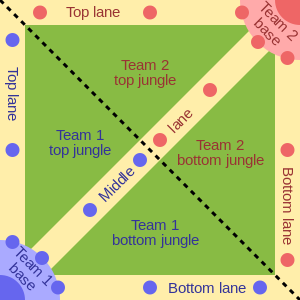
You have 2 bases, 3 lanes, 22 towers, 6 inhibitors/barracks. The intricacies may change between games, but the overall mechanics of a MOBA are basically the same no matter which one you play.
The big difference between MOBAs are the characters. Most popular MOBAs have very large rosters of characters, each with their own unique power sets. There are very few characters that can be identified as particularly "strong" or "weak" because it's all relative to what characters are popular at the time. If one character is popular because of a certain ability, other characters that are good at countering those abilities tend to become more popular while those more susceptible to those abilities become less popular. Then if another type of character becomes popular or if new characters are added or existing character mechanics are modified, things start shifting.
This isn't all that different from how actual sports work.
Let's look at basketball again. In the decades we've been playing it, the way its played has changed a lot, but not because the rules have changed, but because the people playing it have changed the "metagame".
There's another reason why MOBAs work more as a sport than most other video games, and it actually is tied in with the court aspect.
Spectators
Part of what makes a sport a sport is less the game itself and more the community around it. Plenty of sports have been invented, but if you can't get a crowd to show up and watch them, no one will ever care.
"Call of Duty" multiplayer requires a lot of skill, strategy, and physical precision, at least as much as any MOBA does, but as a spectator sport, it's far inferior, and that's because the spectator is rarely given an omnipresent view of the situation, and if they are given one, it is separate from the view given to the players.
Imagine watching a game of football entirely through the perspectives of the players. You'd never really understand what was going on. The player, on the other hand, has the ability to understand pretty much the whole big picture because of the way the field is laid out. They can pretty much see any part of the field at any time they want, though they of course have to pay attention to what's right in front of them as well.
In a shooter, even if you did watch the game from a top-down perspective, it's an experience entirely divorced from what the player is experiencing.
But the way a MOBA is structured makes it function in a way not dissimilar to other spectator sports. The spectator gets the same top-down view that the players have. The players can't necessarily see EVERYTHING due to fog of war, but they can get an idea of the big picture. However, like a football player, it behooves them to get an impression of the big picture as often as possible while still focusing on what's in front of them. Also, one thing that I find fun about watching MOBAs is that some of them allow the spectator to focus on whatever they like. They can see it from the perspective of a player or just look at a general area. The viewer gets to absorb the game as a whole rather than focus solely on one part of it that they can't control.
The one big problem with MOBAs as a spectator sport is fairly obvious to anyone who tries to watch a MOBA game without having played one. It can be confusing.
There are so many characters and abilities and items and strategies that the amount of lingo in a MOBA can be staggering. While this is true about a lot of sports, most sports have a baseline of understanding that can give a new spectator a tenuous grasp on how the game is going. Specifically, a score. When I didn't really understand the rules of football, I could at least understand that bringing the ball to the end of the field was a good thing and that the team with the most points won. I could tell who was winning and I could tell when something good happened for one team when their score went up. If something they did caused the score to go up more, I got the impression that it was a good thing to do.
MOBAs often lack that baseline appeal. Part of what makes a MOBA exciting is that the tide can be turned at almost any point in the game. While most matches are decided very early in the game during the laning phase, a really good jungler or a well-organized team can still pull out a victory if they play their cards right. But it means that it's hard to really grasp something as simple as "who's winning?"
You could get a vague idea of who's winning based on which team has destroyed more towers or which team has farmed more experience and gold or which team has died fewer times, but while those aspects of the game influence the outcome, they don't decide it. Until a base is destroyed, anyone could win.
Chess has a similar problem. While there is a point system to chess that could be used to suggest someone is winning, that's not what decides the game. Until someone has delivered a checkmate, it could be anyone's game. Still, people who walk by while you're playing may still simply ask "who's winning" because unless you play a lot of chess, it's hard to really know who has who on the ropes.
That's kind of the biggest problem with MOBAs as a spectator sport. However, as the video at the beginning of this post points out, MOBAs certainly aren't lacking for spectators.
So why is that? Why do so many people come out for MOBA tournaments than pretty much any other kind? Well, I think there are three main reasons.
First, MOBAs are really popular right now. Thanks to the free-to-play model and the dedicated fanbase for real-time strategy games that built the MOBA genre, MOBAs are played by a lot of people. So naturally, there are a lot of people who understand the games enough to enjoy spectating.
Second, as I already mentioned, MOBAs have the "court" structure which makes them easier to watch than most other competitive games. Fighting games come close, but the problem with fighting games is that the characters aren't different enough to really make a compelling and perpetually evolving metagame. It's why they have to keep making new versions of fighting games every few years. If you just add new characters to an existing fighting game, it throws the whole roster out of balance because while each character has their own special strength and abilities, the basic mechanics of each character are easily compared. At the end of the day, every character kicks, punches, and has some kind of mega-move. But MOBAs tend to deal more with what Extra Credits calls "incomparables" (more on that here if you're interested) where the abilities of one character can be wildly different when compared to another character, particularly when you also have to take into account how they interact with the other members of their team. Even fighting games that allow you to tag out multiple characters and have dozens of characters to choose from like "Marvel Vs. Capcom" tend to gravitate towards a handful of characters that fit particular play-style niches that have developed in the fighting game community over the years. Meanwhile, MOBAs are free to fundamentally alter their entire metagame simply by introducing an innovative new character into the system.
Lastly, even if you don't really understand what exactly is happening, a MOBA is visually interesting. Complex without being too crowded and alienating. When something cool happens in a game, even if a spectator has no clear idea of what exactly is happening and why it matters, they can still tell that it's cool. For example:
You might have no idea what the announcer is talking about. You might have no idea what exactly just happened. You might have no idea why it matters. But in a way, you don't really need to. What did you see? You saw a bunch of those guys with red bars team up and ambush the team with green bars, sucking them into a black hole, but then the green guys dispelled it, sucked them into a black hole, and killed all of them. You don't have to know much to know that "killing all of your opponents at once while being ambushed" is pretty damn cool.
Because all MOBAs have the same basic setup and maps and the only variety is in the characters and the players, you have a game that can be played in virtually infinitely-many ways while still maintaining the basic setup and structure as a point of reference. Everything is built-upon rather than discarded and rebuilt from scratch.
The one big problem with MOBAs as a spectator sport is fairly obvious to anyone who tries to watch a MOBA game without having played one. It can be confusing.
There are so many characters and abilities and items and strategies that the amount of lingo in a MOBA can be staggering. While this is true about a lot of sports, most sports have a baseline of understanding that can give a new spectator a tenuous grasp on how the game is going. Specifically, a score. When I didn't really understand the rules of football, I could at least understand that bringing the ball to the end of the field was a good thing and that the team with the most points won. I could tell who was winning and I could tell when something good happened for one team when their score went up. If something they did caused the score to go up more, I got the impression that it was a good thing to do.
MOBAs often lack that baseline appeal. Part of what makes a MOBA exciting is that the tide can be turned at almost any point in the game. While most matches are decided very early in the game during the laning phase, a really good jungler or a well-organized team can still pull out a victory if they play their cards right. But it means that it's hard to really grasp something as simple as "who's winning?"
You could get a vague idea of who's winning based on which team has destroyed more towers or which team has farmed more experience and gold or which team has died fewer times, but while those aspects of the game influence the outcome, they don't decide it. Until a base is destroyed, anyone could win.
Chess has a similar problem. While there is a point system to chess that could be used to suggest someone is winning, that's not what decides the game. Until someone has delivered a checkmate, it could be anyone's game. Still, people who walk by while you're playing may still simply ask "who's winning" because unless you play a lot of chess, it's hard to really know who has who on the ropes.
That's kind of the biggest problem with MOBAs as a spectator sport. However, as the video at the beginning of this post points out, MOBAs certainly aren't lacking for spectators.
So why is that? Why do so many people come out for MOBA tournaments than pretty much any other kind? Well, I think there are three main reasons.
First, MOBAs are really popular right now. Thanks to the free-to-play model and the dedicated fanbase for real-time strategy games that built the MOBA genre, MOBAs are played by a lot of people. So naturally, there are a lot of people who understand the games enough to enjoy spectating.
Second, as I already mentioned, MOBAs have the "court" structure which makes them easier to watch than most other competitive games. Fighting games come close, but the problem with fighting games is that the characters aren't different enough to really make a compelling and perpetually evolving metagame. It's why they have to keep making new versions of fighting games every few years. If you just add new characters to an existing fighting game, it throws the whole roster out of balance because while each character has their own special strength and abilities, the basic mechanics of each character are easily compared. At the end of the day, every character kicks, punches, and has some kind of mega-move. But MOBAs tend to deal more with what Extra Credits calls "incomparables" (more on that here if you're interested) where the abilities of one character can be wildly different when compared to another character, particularly when you also have to take into account how they interact with the other members of their team. Even fighting games that allow you to tag out multiple characters and have dozens of characters to choose from like "Marvel Vs. Capcom" tend to gravitate towards a handful of characters that fit particular play-style niches that have developed in the fighting game community over the years. Meanwhile, MOBAs are free to fundamentally alter their entire metagame simply by introducing an innovative new character into the system.
Lastly, even if you don't really understand what exactly is happening, a MOBA is visually interesting. Complex without being too crowded and alienating. When something cool happens in a game, even if a spectator has no clear idea of what exactly is happening and why it matters, they can still tell that it's cool. For example:
You might have no idea what the announcer is talking about. You might have no idea what exactly just happened. You might have no idea why it matters. But in a way, you don't really need to. What did you see? You saw a bunch of those guys with red bars team up and ambush the team with green bars, sucking them into a black hole, but then the green guys dispelled it, sucked them into a black hole, and killed all of them. You don't have to know much to know that "killing all of your opponents at once while being ambushed" is pretty damn cool.
Because all MOBAs have the same basic setup and maps and the only variety is in the characters and the players, you have a game that can be played in virtually infinitely-many ways while still maintaining the basic setup and structure as a point of reference. Everything is built-upon rather than discarded and rebuilt from scratch.
Are MOBAs Sports, Or What?
Up until now, I've kind of been dancing around whether or not I think MOBAs count as sports. Instead, I've mostly been effectively talking about why MOBAs seem the most sport-like out of any other game. Why they draw the biggest crowds. Why the champions seem far more impressive. Why they are the most fun to watch. Why people argue for them being sports more than just about any other games out there.
But really, what does it boil down to? What feels so sport-like about MOBAs?
I could cheat and say "the only thing that makes a sport a sport is whether or not a majority of people consider it a sport", but I don't think that's true. I think there's something more fundamentally intrinsic to sports that make them stand out. And I think it's the idea of a game around a game.
I'm not talking about the metagame, although that's certainly part of it. I'm talking about the narrative of a sport.
I was never really into sports growing up and I still pretty much don't care all that much, but I was often confused as to why some people got into it as much as they did. Why they cared so much about teams that didn't even represent their own hometown or state, why they wore the jerseys of players, why they constructed and competed with fantasy teams. Eventually, I realized that the answer to my question was basically the question itself. People care because people care.
A simple game of American football is exactly that. A game. But there's more going on than just that game. There's a metagame being played by the managers and coaches where they decide what new players to add to the team and which old players to trade or retire. Every new season, fans watch closely to decide whether the changes have made their favorite team better or worse. It makes them grow attached to individual players, particularly if they have interesting life stories.
Just look at fantasy football. It's a game built around the idea of managing a game, not playing it. And it's insanely popular. It's because that's really the part that people love about American football. American football as a game is actually pretty boring. It's slow-paced, scored in a bizarre manner, and has a lot of weird rules that are hard to explain. But as a sport, it's deep, engaging, and ever-changing. I don't really care for it, but I understand why people get so wrapped up in it.
In order for a game to be elevated to a sport, a single game has to mean more than "just a game". The outcome of every individual game has to build to a greater whole. Each victory and loss has to matter. Each player (and in the context of MOBAs, character) has to be evaluated and have their own story.
And while it's still rather underground and mostly niche, MOBAs are starting to develop that. The ever-evolving rosters of the games change strategies every year in the same way new draft picks can change an entire season of American football. Teams are starting to forge identities of their own with star players with ambitions, dreams, rivalries, signature styles and strategies. In a way, playing a MOBA while tangentially aware of the high-level strategies being employed by the pros influences the play-styles and character choices of the more casual players.
Also, there really isn't a sport quite like a MOBA that currently exists, and for that matter, there really can't be. A fighting game or a shooter can be just as easily represented in real life, albeit with some limitations, but the core gameplay would be there. Why watch a video game of two fighters when you could watch a boxing match? Why watch a CoD game when you could watch or play a game of paintball or laser tag? But a MOBA can't really be represented in real life. You can't represent the complex power sets or the respawn times or the farming or the murdering. It can really only be represented digitally. Even just the basic goal of "destroy a base" can't be represented accurately in real life.
So I think out of all video games, MOBAs are kind of poised the most to actually thrive in the competitive community at this point. So long as the core gameplay remains the same and the crowds keep getting larger and the coverage gets better and the characters keep shuffling, I think it can stand the test of time. Maybe not the games themselves, but unlike fighting games, the individuals MOBAs don't matter as much as the universality of the game mechanics. So long as the court never fundamentally changes, the crowds will just keep growing.
Thursday, December 5, 2013
Burning Under the Spotlight - A "Catching Fire" Review
I liked the first "Hunger Games" film quite a bit. I hadn't read the book (and I still haven't... I'm bad at reading) so I went into the movie knowing very little and I left more-or-less satisfied. Like many people, I had a number of qualms with it. Most people cited the shaky-cam or lack of originality as the bigger complaints, but I honestly found those to be minor problems. The shaky-cam was necessary to obscure the violence enough to score a PG-13 rating, crucial for a film like this. And yeah, we'd seen movies like it before, but "Hunger Games" did enough differently to stand apart and justify it's existence.
My biggest problem with "Hunger Games", as I've said before, was that Katniss was never put in a situation where her survival meant doing something morally compromising. Every time the movie almost gave her an impossible situation, they found a way to rob her of it. When (SPOILER ALERT) Rue died, I was upset, but not largely because I particularly cared about Rue as a character, but because her sudden death robbed the film of an interesting question. Suppose everything went Katniss' way. Suppose she and Peeta and Rue all survived until the end of the Hunger Games as the last three standing. Then what? Would she have tried her berry-eating routine with Rue, too? Would that have worked? Would she have sacrificed herself to save Rue knowing that she wouldn't have been able to return to the sister that Rue so reminds her of? Would Rue have been able to live knowing that Katniss and Peeta gave their lives for her? Rue's death at the hands of some random shmoe meant Katniss would never have to make a hard decision for her survival. And that's kind of how that entire film works. Most of Katniss' enemies either die off screen or she only kills them after they do something horrible. I left the theater liking Katniss but not exactly knowing much about who she really was.
Luckily for me, "Catching Fire" tackles this particular angle head-on, almost from the very beginning, and we end up with a film that's more engaging, more complex, and far more enjoyable than the previous.
My biggest problem with "Hunger Games", as I've said before, was that Katniss was never put in a situation where her survival meant doing something morally compromising. Every time the movie almost gave her an impossible situation, they found a way to rob her of it. When (SPOILER ALERT) Rue died, I was upset, but not largely because I particularly cared about Rue as a character, but because her sudden death robbed the film of an interesting question. Suppose everything went Katniss' way. Suppose she and Peeta and Rue all survived until the end of the Hunger Games as the last three standing. Then what? Would she have tried her berry-eating routine with Rue, too? Would that have worked? Would she have sacrificed herself to save Rue knowing that she wouldn't have been able to return to the sister that Rue so reminds her of? Would Rue have been able to live knowing that Katniss and Peeta gave their lives for her? Rue's death at the hands of some random shmoe meant Katniss would never have to make a hard decision for her survival. And that's kind of how that entire film works. Most of Katniss' enemies either die off screen or she only kills them after they do something horrible. I left the theater liking Katniss but not exactly knowing much about who she really was.
Luckily for me, "Catching Fire" tackles this particular angle head-on, almost from the very beginning, and we end up with a film that's more engaging, more complex, and far more enjoyable than the previous.
No Spoilers
A running theme in "Catching Fire" is really about what I discussed above. Katniss in the first film had two major motivations: to survive and to be a decent human being. At no point in the first film did she have to choose one over the other. This leads the insane President Snow to believe that Katniss, whose efforts to be a decent human being have inspired a fledgling uprising, is not the revolutionary many seem to believe her to be and that when push comes to shove, she'll save her own neck before laying herself on the line for others.
This actually serves as a major point of conflict for her character. See, for Katniss, survival isn't really a selfish desire. She wants to survive for the sake of her sister and her mother and her friends. Yet her survival almost entirely depends on her willingness to cooperate with President Snow. She knows that any act of defiance will put her loved ones at considerable risk. But as events continue to escalate, she comes closer and closer to the inevitable decision between doing the right thing and putting herself and her loved ones in harm's way. And how she handles that decision, in the end, is a truly defining moment for her as a character and really drives this movie in a way the first film didn't.
The direction here is great, and not just because Francis Lawrence knows how to use a tripod. Say what you will about Lawrence's other works, the guy knows how to frame a shot. But more than that, I've always felt like he was very good at evoking a character's personality through simple visuals rather than through dialogue. While "Constantine" is a mess in terms of plot, dialogue, and pacing, I love watching it if only for the larger-than-life feel of most of the characters. Like the first "Hunger Games", most of this film sticks to the book's limited point-of-view around Katniss. The viewer rarely knows more than Katniss does. In fact, unlike the book, we are often left knowing less than Katniss does. Still, through very excellent and subtle acting and cinematography, we always know exactly what Katniss is thinking or feeling without her having to say a word. That takes skill and restraint.
Some may say that this film's weakness is that it doesn't stand on it's own, and I've said before that that doesn't really bother me. Sure a film that can stand on its own and function as a good sequel is ideal, but for me, it's extra credit. So long as the film that came before it is worth watching, I don't mind doing a little extra homework.
The few weaknesses the film does actually have are actually fairly difficult to articulate, but I'll do the best I can. While I can understand perfectly well why we are limited to Katniss' perspective through the majority of the film, I do think they could have eased back a little bit on it. Film is a visual medium and being told about a thing that's happening is almost always less interesting than actually seeing it. That said, some of the things we do see are at times not very interesting. If you can't create a convincing CGI baboon-thing, you probably shouldn't center an entire action sequence around them. Just saying.
All-in-all, though, I was extremely satisfied with this film and would recommend checking it out.
Subscribe to:
Posts (Atom)